Nambix

Blogs

ai captioning
Blogs

ADA & WCAG Compliance in 2026: How AI Captioning Helps Businesses Stay Legally Safe

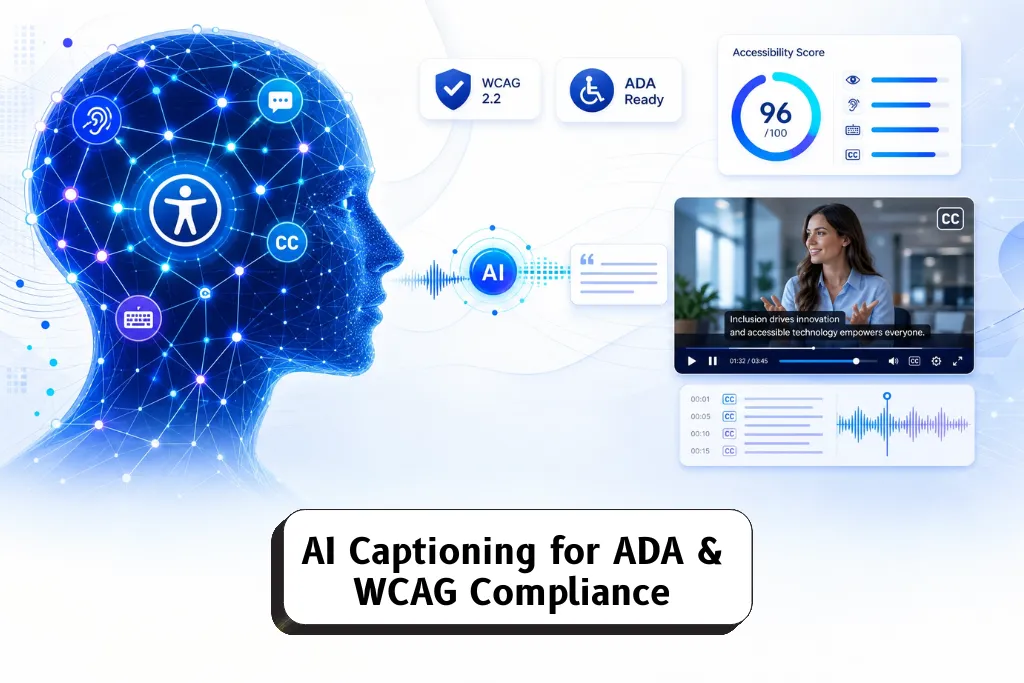
In 2026, ADA WCAG compliance is no longer optional — it is a binding legal requirement for businesses operating websites, apps, and digital platforms. This blog explains what the Web Content Accessibility Guidelines (WCAG) demand from website owners today, how the European Accessibility Act has expanded these obligations globally, what success criteria your digital content must meet to avoid lawsuits, and how AI-powered captioning helps your business achieve Level AA conformance quickly and cost-effectively — while providing equal access to people with disabilities across every web page you publish. Understanding ADA WCAG Compliance and Digital Accessibility in 2026 The Americans with Disabilities Act has long required businesses to provide equal access to their goods and services — and courts have consistently extended this to digital channels under Title III. In parallel, the World Wide Web Consortium, through its Web Accessibility Initiative, developed the Content Accessibility Guidelines WCAG as the accepted technical standard for making websites accessible to people with different disabilities, including those with hearing loss, visual impairments, motor difficulties, and learning disabilities. The most current version, WCAG 2.2, builds on WCAG 2.1 and WCAG 2.0 with new success criteria focused on user interface components, input purpose, and mobile devices. Level AA remains the widely accepted benchmark for legal compliance, while Level AAA conformance represents the highest tier of accessibility — aspirational for most organisations but required in some regulatory contexts. The European Accessibility Act, which came into full enforcement in June 2025, further raised global stakes by requiring products and services in information and communication technology — including websites and digital media — to meet accessibility standards across EU member states. For businesses operating internationally, digital accessibility is no longer a domestic compliance issue. The rules apply across borders, and businesses that ignore them risk simultaneous exposure in multiple jurisdictions. Why Captions Are Central to WCAG Compliance and Specific Requirements Among the specific requirements in WCAG, captioning is one of the most explicitly mandated. Success Criterion 1.2.2 at Level AA requires that all prerecorded audio in synchronized media must provide captions. Success Criterion 1.2.4 extends this to live broadcasts. These are hard conformance requirements, not soft recommendations. Text alternatives and captions allow information presented through audio-visual formats to reach users with hearing loss, people in sound-restricted environments, and those using assistive technologies like screen readers. Without captions, a web page containing video content automatically fails Level AA conformance — exposing businesses to legal risk under both the disabilities act and international frameworks like the European Accessibility Act. WCAG guidelines further require that captions accurately reflect spoken dialogue, identify speakers, and capture non-speech sounds that are meaningful to understanding the content. This raises the quality bar beyond basic auto-generated text, making AI captioning with high accuracy the only practical and scalable solution for most organisations. New Success Criteria, User Interface Components, and the European Accessibility Act WCAG 2.2 introduced several new success criteria that website owners must now address. Focus Appearance at Level AA ensures that user interface components like buttons and form fields have a visible keyboard focus indicator. Accessible Authentication reduces cognitive barriers from login flows, benefiting users with learning disabilities. Color contrast requirements remain essential, and a website’s layout must be navigable without reliance on visual elements alone. The European Accessibility Act aligns closely with WCAG Level AA, meaning WCAG conformance is the practical path to compliance for most digital businesses in EU markets. For government websites and federally funded entities in the US, the Rehabilitation Act similarly mandates conformance with the current version of the web content accessibility guidelines. Taken together, these frameworks mean that a web accessibility policy is now a business necessity, not a best-practice recommendation. How AI Captioning Helps Businesses Fix Accessibility Issues at Scale Large organisations publish hundreds of hours of video content yearly across training, marketing, and customer service channels. Manually captioning this volume is cost-prohibitive. AI captioning resolves this bottleneck — processing video in real time, generating accurate captions across multiple languages, and producing output formatted to meet WCAG requirements, including proper punctuation, speaker identification, and synchronized text alternatives. AI captioning can also be integrated into live broadcast environments, satisfying the Level AA requirement for live captions. This makes it relevant not just for prerecorded content but for webinars, live events, and real-time communication technology platforms — all of which fall within scope of the European Accessibility Act and the Rehabilitation Act. For website owners who have been avoiding compliance due to cost, AI captioning removes the primary financial barrier. Improving accessibility across an entire website’s video content is no longer a multi-year manual project — it is an automated workflow that scales with your content output. Nambix Technologies offers AI Captioning services purpose-built for businesses that need to meet WCAG requirements at scale. With accuracy up to 99.8% and real-time processing, Nambix delivers captions that satisfy the technical standard for Level AA conformance — covering both prerecorded and live content across web pages, mobile devices, and digital platforms. Beyond captioning, Nambix provides AI Transcription, AI Subtitling, and AI Translation, enabling businesses to achieve digital accessibility and WCAG compliance at scale. To learn more or request a demo, visit https://nambix.com/ Frequently Asked Questions (FAQs) 1. What is the difference between ADA compliance and WCAG conformance? ADA compliance is the legal obligation to provide equal access to people with disabilities, including through digital channels under Title III. WCAG conformance means meeting the specific success criteria in the web content accessibility guidelines. Courts treat WCAG Level AA as the practical benchmark for ADA compliance — meaning failing to provide captions for video is both a WCAG failure and potential legal exposure. Nambix’s AI Captioning delivers accurate, properly timed captions formatted to the technical standard WCAG requires, helping businesses satisfy both the legal requirement and the conformance criteria on the same page. 2. Does WCAG 2.2 replace WCAG 2.1, and do I need to update my website? WCAG 2.2 is the most current version and is backward compatible with WCAG 2.1 and WCAG 2.0. It adds new

video captioning services
Blogs

Video Captioning Services for eLearning: Making Online Courses Accessible Worldwide

This blog explains how video captioning services help eLearning creators and online course platforms deliver accurate transcription, multilingual subtitles, and closed captions that make educational video content fully accessible to a global audience. From leveraging AI-powered captioning tools to combining automated and human transcription workflows, this guide covers everything educators, instructional designers, and eLearning platform operators need to know about adding accurate subtitles to course videos — and how doing so boosts learner engagement, drives accessibility compliance, and expands reach across multiple languages worldwide. Why eLearning Cannot Afford to Skip Video Captioning Services The global eLearning market is on an unstoppable growth trajectory, with learners tuning in from every corner of the world. Yet a significant portion of video content is still published without captions — silently locking out non-native speakers, learners with hearing impairments, and students watching in noisy environments where audio is not practical. Video captioning services solve this by converting the spoken content in course videos into perfectly synced on-screen text. This isn’t simply an accessibility checkbox — it’s a measurable business advantage. Research consistently shows that courses with accurate captions enjoy higher watch time, stronger completion rates, and better knowledge retention. Closed captions also make every word of your video content crawlable by search engines, helping your course catalog rank higher and reach a wider audience organically. For eLearning platforms serving global learners across time zones, languages, and learning conditions, the presence or absence of captions often defines whether a course succeeds in new markets. How AI-Powered Transcription Is Transforming eLearning Content Traditional manual transcription was slow, expensive, and difficult to scale for large course libraries. Today, ai powered transcription has fundamentally changed how eLearning teams produce and publish content. Driven by automatic speech recognition and natural language processing, modern ai transcription platforms can process audio files and video files with remarkable speed — turning hours of recorded lectures into accurate transcripts in minutes. The best transcription services now combine the efficiency of machine learning with the refinement of human transcription. This hybrid approach ensures that the final output meets the high quality that eLearning demands — especially when dealing with multiple speakers, technical vocabulary, background noise, or content recorded in noisy environments. For eLearning teams managing longer videos or entire content libraries, the ability to auto generate subtitles through ai tools isn’t just a convenience — it’s a competitive necessity. Automated transcription services dramatically cut production timelines while maintaining transcription accuracy across multiple languages, enabling faster go-to-market across global regions. The Power of Accurate Subtitles for Global Learners When course creators add subtitles to their video content, they are doing far more than meeting compliance requirements. Accurate subtitles make your spoken content legible and comprehensible for global learners — whether they are watching via mobile apps on a commute, studying in a second language, or accessing courses in regions with unreliable internet audio. Closed captions serve a dual purpose: they support learners with hearing difficulties (a legal requirement in many countries) and enhance comprehension for all learners processing complex, fast-paced, or technical audio content. Standard caption formats like SRT and VTT integrate smoothly with most LMS platforms, while speaker identification and speaker labels help learners follow multi-participant discussions such as panel lectures or group tutorials. Adding captions through professional video captioning services also delivers significant SEO value. Search engines read caption files and automated transcripts, effectively turning every spoken word in your course into indexed, searchable text — boosting discoverability and driving more organic traffic to your eLearning platform. Choosing the Best Transcription Services for eLearning Not all transcription tools are built equally. When evaluating the best transcription apps and platforms for eLearning, course creators should look beyond pricing and consider: Transcription accuracy across accents, technical terms, and speaker names Support for multiple languages to serve international learners Speaker identification for recordings that involve multiple speakers Flexible export options for subtitle files in SRT, VTT, and TXT formats Collaboration features for team review, the ability to edit subtitles, and quality control workflows Integration with tools like Google Drive, your LMS, or media platforms for smooth video upload and the ability to export transcripts quickly The best transcription apps today deliver ai powered transcription as a baseline, then layer in human-powered transcription review for high-stakes or domain-specific audio recordings — exactly the combination eLearning producers working with technical, medical, or legal content need most. Look for platforms that support data annotation pipelines for specialized vocabulary and offer team collaboration capabilities when multiple reviewers are involved. Nambix Technologies: AI-Powered Video Captioning Built for eLearning Scale Nambix Technologies offers enterprise-grade video captioning services and AI transcription solutions built for teams that need speed, high accuracy, and global scale. eLearning providers can upload audio files and video files — from short micro-lessons to longer videos spanning several hours — and receive perfectly synced, highly accurate captions delivered rapidly. Nambix’s AI captioning and ai powered transcription services leverage advanced automatic speech recognition, natural language processing, and data annotation workflows to produce accurate captions even in challenging conditions — background noise, multiple speakers, or content recorded across multiple languages. Their platform supports speaker identification, speaker labels, and multiple caption formats to match your LMS requirements precisely. For teams requiring the most accurate transcription, Nambix blends automated transcription services with professional human transcription review — ensuring that completed transcripts and auto captions meet the quality bar that eLearning content demands before reaching global learners. Whether your goal is to add subtitles to a single course or run automated transcriptions across a full content library, Nambix provides the technology and expertise to make it scalable. Their AI captioning services also help highlight key points within transcripts through ai summary features, making content easier for learners to navigate — while their multilingual captioning capabilities help eLearning platforms expand to a global audience with accurate subtitles in dozens of languages. Frequently Asked Questions (FAQs) 1. What are video captioning services, and why does eLearning need them? Video captioning services convert the spoken content in a video into on-screen text that is perfectly synced with the audio. For eLearning, captions ensure that global learners — regardless of language, hearing ability, or listening environment — can fully access course content.

mtpe
Blogs

AI + Human Editing: When MTPE Is the Right Choice for Your Business

AI + Human Editing: When MTPE Is the Right Choice for Your Business Machine translation post-editing (MTPE) is a hybrid translation workflow in which a machine translation engine generates a first-draft translation from the source text, and then professional human post editors review, correct, and refine that machine translated output to meet defined quality standards. This blog explains what MTPE is, how the post editing process works — including pre editing, the difference between light post editing and full post editing, and the role of translation memory and a translation management system — so your business can decide when MTPE is the right approach to achieving high quality translations across multiple language pairs, quickly and cost-efficiently. What Is Machine Translation Post-Editing (MTPE)? Machine translation post editing — commonly written as MTPE or translation post editing MTPE — is the practice of refining raw machine translation output using targeted human expertise. Unlike traditional translation, where human translators work entirely from scratch, MTPE uses a machine translation engine to produce a baseline draft, which experienced post editors then elevate to publication-ready quality. Modern neural machine translation systems can produce largely grammatically correct, fluent output rapidly across many language pairs. However, machine translation still falters with cultural nuances, idiomatic expressions, brand voice, and complex sentence structures. These are the gaps that human post editing fills. Post editing aims to transform raw machine translation — which may contain grammatical errors, spelling mistakes, and awkward phrasing — into accurate, natural-sounding content in the target language. The result pairs the speed of an automated process with the precision of human judgment. How the Post Editing Process Works: From Pre Editing to Approved Translations A structured post editing process moves through clear stages from source text preparation to final delivery. Pre Editing the Source Text Pre editing is one of the most effective ways to improve machine translation quality before human editors even begin. Human linguists clean the source text — simplifying complex sentence structures, resolving ambiguities, and standardising technical terms — so that the machine translation engine has the best possible input. A well pre edited source language input directly helps reduce post editing effort downstream. Processing Through the Machine Translation Engine The pre edited text is processed by a neural machine translation engine to produce a machine generated translation at speed. This draft becomes the working baseline for post editors. Human Post Editing Skilled post editors — professional translators with domain expertise — compare the machine translated content against the source text. They correct grammatical errors, fix spelling mistakes, ensure correct terminology, adapt cultural nuances, and align the translated output with the brand’s established voice. Quality estimation tools help flag weaker segments of the MT output, directing human effort where it is most needed and improving post editing efficiency overall. Translation Memory and Final Review A translation management system integrates translation memory — a repository of previously approved translations — to ensure that technical terms and brand language are translated consistently. A final human review confirms that the translated output meets quality standards before delivery. Light Post Editing vs. Full Post Editing: Choosing the Right Level Light Post Editing Light post editing focuses on making machine translated content reach acceptable quality for internal use, understanding user generated content, or high-volume low-risk material. Light post editing focuses on correcting outright errors — spelling mistakes, grammatical errors — without over editing segments that are already at the required standard. It minimises human effort while keeping the post editing process efficient. Full Post Editing Full post editing brings machine translated content to a quality comparable to traditional human translation. Post editors refine the machine translation output for accuracy, fluency, cultural nuances, brand voice, and correct terminology throughout. Full post editing is appropriate for customer-facing content, legal documents, healthcare materials, and anything where translation quality directly affects trust or compliance. Matching Level to Purpose How much post editing depends on content type, audience, and risk. A translation management system, paired with quality estimation, helps teams make consistent decisions — keeping overall translation efficiency high across all projects. When Is MTPE the Right Choice for Your Business? MTPE is the right choice when you need to balance translation efficiency with translation quality — and raw machine translation alone is insufficient, while fully manual translation is too slow or costly. Consider MTPE when you need to scale content across multiple languages quickly, translate large volumes of e-commerce descriptions, technical manuals, or support documentation at consistent quality, or maintain brand language and correct terminology across all language pairs without the cost of manual translation. Translation memory and a translation management system let you build on approved translations over time, steadily reducing post editing effort as your library grows. That said, highly creative or extremely sensitive content may still benefit from pure human translation, where machine translation post would introduce more complexity than value. How Translation Memory and a Translation Management System Reduce Post Editing Effort Translation memory stores approved translations of previously processed segments. When similar content appears again, post editors don’t repeat work — the system surfaces the stored result instantly. This reduces human effort, speeds up the translation workflow, and keeps technical terms and brand language translated consistently across projects. A translation management system ties the entire process together: housing translation memory, brand glossaries, style guides, and quality estimation tools in one platform. When integrated with a reliable machine translation engine and experienced post editors, it delivers high quality translations at a scale that traditional translation cannot match. Conclusion: Translate Smarter, Scale Faster Machine translation post editing is a strategic approach to achieving high quality translations at the speed and scale modern businesses demand. Whether you need light post editing for internal content or full post editing for customer-facing material, a well-built MTPE workflow — powered by a strong machine translation engine, experienced post editors, translation memory, and a reliable translation management system — consistently outperforms raw machine translation at a fraction of the cost of traditional translation. Explore Nambix Technologies’ MTPE

ai translation
Blogs

How AI Translation Reduces Localization Costs for Global Companies

How AI Translation Reduces Localization Costs for Global Companies AI translation reduces localization costs for global companies by automating content conversion across multiple languages using neural machine translation, translation memory, and AI-powered workflows — cutting per-word translation pricing by up to 80% compared to traditional human translation, while maintaining enterprise-grade accuracy and brand consistency. This blog explains how AI translation tools work, where they outperform conventional approaches, and how businesses can build a scalable, cost-efficient multilingual communication strategy. The True Cost of Traditional Human Translation For decades, global businesses have relied on a professional translator — or entire teams — to localize content market by market. While human translation delivers nuance, a skilled translator typically charges $0.04 to $0.30 per word rate that can vary depending on the language pair, content complexity, and turnaround time. For a company managing document translation across ten or twenty markets, the total cost compounds rapidly. Translation services for a single product launch across French, Spanish, German, and several Asian languages can run into tens of thousands of dollars. Add a translation management system, localization expert fees, and revision rounds, and the cost of multilingual content quickly becomes a barrier for companies trying to enter new markets. How AI Translation Tools Are Changing the Cost Equation Modern ai translation tools — powered by neural machine translation (NMT) — do far more than simply translate text word-for-word. Unlike older rule-based machine translation systems or basic tools like Google Translate and Microsoft Translator, today’s enterprise-grade NMT engines analyze full sentences in context, understand domain-specific terminology, and generate natural sounding translations that reflect the intent of the source language. Key cost drivers that AI translation directly addresses include: Volume: An ai platform can process millions of characters in a fraction of the time it would take a human team. What a professional translator completes in a week, an AI translator handles in hours — without compromising translation quality on routine or structured content. Scale across language pairs: Expanding from two languages to twelve no longer means hiring twelve separate teams. AI translation agent workflows can handle dozens of language pairs simultaneously from a single pipeline, turning what was a linear cost into a near-flat one. Translation memory: AI-powered systems store previously translated segments in a translation memory database. When similar or identical content appears again — across product updates, documentation revisions, or seasonal campaigns — the system reuses approved translations automatically, eliminating redundant translator costs on repeated word count. Custom glossaries and style guides: Enterprise ai translation tools support custom glossaries and style guide integration, ensuring that brand voice consistent output is delivered in every target language without manual rework. This keeps translated content accurate and on-brand across markets. AI Translation vs. Human Translation: Finding the Right Balance It is worth mentioning that ai translation is not a wholesale replacement for human translation in every context. The smartest global companies use a tiered model: AI does the heavy lifting for high-volume, structured content — think product descriptions, support documentation, UI strings, and internal communications — while a localization expert or professional translator focuses their effort on high-stakes content where cultural nuance, legal accuracy, or persuasive tone matter most. This hybrid model — often called Machine Translation Post-Editing (MTPE) — pairs the speed and scale of machine translation with human oversight for quality assurance. The result is translation quality that rivals fully human workflows at a fraction of the cost. For example, if a global e-commerce brand needs to translate 500,000 words of product catalog content into Spanish and French, routing that through an AI translator with light post-editing can reduce translator costs by 60–70% compared to full human translation, while keeping the original formatting intact and the output ready for publication. What to Look for in an AI Translation Agent for Enterprise Use Not all ai translation tools are created equal. When evaluating an ai translation agent for enterprise use, global companies should look for: Support for how many languages they currently need — and may need as they scale Document translation capabilities across formats, including PDFs, Word files, HTML, subtitle files, and multimedia assets, preserving original formatting without manual reconstruction Enterprise grade security with data confidentiality controls, especially for legal, healthcare, and BFSI sectors A translation management system that integrates with CMS and product pipelines for continuous, automated localization AI powered language tools that support terminology management, so every piece of translated content reflects the organization’s approved vocabulary across one language or multiple languages These factors determine whether an ai platform will genuinely reduce costs — or simply shift manual effort from translation to quality control. The Real ROI: Speed, Scale, and Market Reach Beyond direct translation pricing savings, the business case for AI translation extends into competitive advantage. Companies that localize content faster enter markets sooner, respond to local customer needs more quickly, and maintain brand voice consistent messaging globally without the delays of manual workflows. Multilingual communication is no longer a luxury — it is a requirement for any company operating across borders. With AI translation, what was once a six-figure localization budget becomes a manageable, predictable line item that scales with business growth. Frequently Asked Questions (FAQs) 1. How much can AI translation actually reduce localization costs compared to human translation? AI translation can reduce localization costs by 50–80% compared to traditional human translation, especially for high-volume and structured content like product pages, support articles, and documentation, where automation and translation memory eliminate repetitive work and make pricing more predictable at scale. Solutions like Nambix Technologies further optimize this by automating routine workflows and applying human review only where it adds value, with MTPE (Machine Translation Post-Editing) combining machine speed and human accuracy to deliver an optimal cost-quality balance. 2. Is AI translation accurate enough for professional business content? Modern AI translation is accurate enough for most professional business content, producing natural, context-aware translations when supported by glossaries, style guides, and translation memory, though human review is still important for sensitive or regulated content. Platforms like Nambix enhance this further by achieving up to 99.8% accuracy

ai translation services
Blogs

AI Translation Services vs. Human Translation in 2026: Which One Should You Choose?

In 2026, businesses and individuals choosing between AI translation services and human translation need to consider speed, scale, use case, and regulatory requirements. AI translation uses neural machine translation and advanced language tools to instantly translate text across multiple languages — delivering exceptional accuracy, workflow automation, and cost-efficiency at scale. Professional translation services complement AI by fulfilling specific regulatory and certification mandates for official documents. This blog breaks down both approaches — from high-volume multilingual communication to certified translations for official use — helping you build the right translation strategy for your business, whether you are a startup expanding globally or an enterprise managing multilingual content across dozens of markets. What Are AI Translation Services? How They Translate Text in 2026 Modern AI translation represents one of the most significant leaps in language services in decades. Powered by neural machine translation (NMT) and deep learning, today’s AI powered platforms can translate text between dozens of language pairs — Spanish, French, German, Italian, Portuguese, Japanese, Chinese, and many more — in seconds. Unlike basic consumer tools such as Google Translate, enterprise-grade AI translation services are purpose-built for professional use: they leverage translation memory to store and reuse previously approved translations, ensuring consistent terminology and brand voice across all documents and projects. These platforms allow teams to upload files, paste text, or integrate directly with a CMS or product pipeline for seamless workflow automation. With optional human review available as part of the translation process, businesses can configure exactly the level of oversight they need — balancing turnaround time, cost, and quality on a project-by-project basis. The result is a scalable, cost-efficient solution that removes language barriers at speed, empowering teams to publish multilingual content across global markets without delays or bottlenecks. What Is Human Translation — And How Do Professional Translators Complement AI? Human translation is performed by a professional translator who works alongside or after AI to provide cultural refinement, domain-specific expertise, and formal certification for content that requires it. In professional translation workflows, human translators review translated content for tone, contextual alignment, and terminology accuracy — adding a layer of quality assurance that is particularly valued in high-stakes communications and compliance-sensitive industries. More importantly, certain document types are governed by legal and governmental standards that require a qualified human signatory. Certified translations for immigration applications, academic credentials, court filings, and official government submissions must carry the certification of a qualified professional translator as mandated by the relevant authority. This is a regulatory distinction — a compliance requirement set by law — rather than a reflection of AI capability. For these document types, professional translators fulfill the formal certification role that official processes demand, making them a natural and essential part of a complete language services ecosystem. AI Translation vs. Professional Translation Services: Key Differences Understanding the role each approach plays helps businesses make smarter decisions about how to structure their translation process. Speed: AI translation services deliver near-instant results. Whether you need to translate a 10,000-word product catalog or a single web page, automated language services operate around the clock with consistent output and rapid turnaround time. Professional translators work within human capacity limits, making AI the clear choice for time-sensitive and high-volume projects. Cost: AI translation dramatically reduces per-word costs through automation, making large-scale multilingual content accessible even for growing teams. Professional translation services are typically engaged for specific content types or compliance workflows where a human signatory is required. Accuracy: Today’s AI translation services deliver exceptional accuracy across all major language pairs. Enterprise NMT platforms are trained on domain-specific data — covering legal, medical, technical, and marketing content — and use translation memory and glossary controls to maintain consistency across every project and language pair. Scalability: AI platforms scale effortlessly. Businesses managing multilingual communication across ten or twenty languages simultaneously can process entire content libraries in the time it would take a human team to handle a fraction of the volume. Certified Translations: For documents intended for official use, legal authorities and government bodies require certified translations carrying the formal attestation of a qualified professional translator. This is a regulatory standard set by governing institutions — and professional translators are the designated signatories for this purpose. When AI Translation Is the Right Choice (Including Expedited Service) AI translation is the ideal choice for the vast majority of business translation needs: Turnaround time is critical. An expedited service powered by AI can process thousands of words overnight, making it indispensable for global product launches, marketing campaign rollouts, or urgent website localization across multiple markets. Content volume is high. Blog posts, support documentation, product descriptions, e-commerce listings, and app interfaces all translate efficiently through AI at consistent quality and speed. Workflow automation drives your operations. Modern AI powered translation platforms integrate with content management systems, app repositories, and customer support tools — automating handoffs and eliminating delays in the translation process. Multiple languages are needed simultaneously. AI handles dozens of language pairs in a single project without proportionally increasing cost or delivery time, making it the backbone of any global content strategy. Optional human review fits your quality workflow. AI platforms with built-in optional human review give businesses the flexibility to add professional translators as a refinement layer for content that benefits from an additional pass — without sacrificing speed or efficiency. When Regulatory and Compliance Needs Call for Professional Translation Services and Certified Translations Certain content types are governed by institutional requirements that bring professional translators into the process — not as a substitute for AI, but as a compliance necessity: Certified translations for official use. Immigration applications, academic transcripts, court filings, and government documents require certified translations with formal attestation by a qualified professional translator, as mandated by the relevant legal or governmental authority. Legal and medical documentation for submission. For documents intended for official submission in the legal and healthcare industries, compliance protocols often specify that a qualified professional translator must certify the final output. MTPE workflows for compliance-grade content. Machine Translation Post-Editing combines AI’s speed with professional review, meeting institutional standards while keeping the translation process efficient and cost-effective. Creative and brand-sensitive

ai subtitling
Blogs

AI Subtitling vs. Manual Subtitling: Cost, Speed & Accuracy Compared

What Is AI Subtitling and How Does It Work? AI subtitling uses speech recognition and machine learning to auto generate subtitles from your video file’s audio track. When you upload your video to an AI-powered platform, the system processes the audio, transcribes speech into text, syncs each subtitle line to precise timestamps, and delivers a ready-to-use SRT file — all without downloading software. Modern auto subtitle generator platforms go further: you can edit subtitles, customise subtitle font, apply subtitle styles, translate into multiple languages, and export subtitle files — all inside a single online subtitle editor. Whether you’re adding captions to an Instagram video or handling longer videos for YouTube, the entire flow from video upload to finished editing takes a few clicks. Manual subtitling, by contrast, involves a human transcriptionist listening to audio files and typing every word, then hand-timing each subtitle entry. Effective for nuanced or highly specialised dialogue — but time-intensive, expensive, and difficult to scale. AI Subtitling Auto generates subtitles in minutes Scales to any volume of video Supports 100+ languages Built-in edit & style tools SRT file export in one click No specialist skill needed Manual Subtitling High contextual accuracy Slow turnaround (hours–days) High cost per minute of video Hard to scale across languages Relies on specialist availability Revisions go back to vendor The Real Cost of Generate Subtitles: AI vs. Manual Cost is where the gap becomes most visible. Manual subtitling typically runs $1.50–$7 per minute of video, and for longer videos, multi-language projects, or hardcoded subtitles, the bill climbs fast. Each revision cycle adds further expense. AI subtitling slashes those costs by 60–80%. Most auto subtitle platforms process entire video content libraries at predictable, low per-minute rates — and many offer a subtitle generator free tier for shorter clips. For content creators and enterprises producing high volumes of social media videos, the savings compound quickly: lower unit costs, no vendor coordination, and no extra charge per language when you need to reach a global audience. Speed: Auto Subtitle in Minutes, Not Days Manual subtitling turnaround ranges from a few hours for short clips to multiple days for complex productions. When you’re running a publishing calendar for YouTube, social media, or enterprise video, delays directly hurt watch time and reach. An ai subtitle generator eliminates that bottleneck. A 30-minute video file can have perfectly synced auto captions ready in under five minutes. Even after you edit subtitles — adjusting word choice, tweaking timing, or choosing a new subtitle font — you’re back to publishing within minutes of finished editing. For video creation at scale, this speed advantage is irreplaceable. Accuracy: Can You Get Accurate Subtitles from AI? Accuracy is the most debated dimension — and the truth is nuanced. For clear speech, standard accents, and professional audio files, today’s ai subtitling achieves up to 99.8% accuracy. Automatic subtitles generated this way are virtually indistinguishable in quality from manually crafted ones. Accuracy benchmark — clear audio AI Subtitling (clear audio)99.8% Manual Subtitling~99%+ AI Subtitling (heavy accent / noise)~88–92% Manual subtitling holds an edge for heavy accents, strong background noise, or creative dialogue with rich cultural context. In those scenarios, a hybrid approach — combining an ai subtitle generator with human review (MTPE) — delivers the accuracy of manual work at close to AI speed and cost. For the vast majority of video subtitles — corporate content, e-learning, social media videos, and marketing — AI delivers accurate captions that meet professional standards every time. Edit Subtitles, Add Captions & Customise Subtitle Font for Your Video Content A concern creators raise about automatic subtitles is flexibility: can you really customise the output? Yes — comprehensively. After auto generate runs, modern platforms let you edit subtitles for word accuracy, adjust timing, change subtitle font and apply own fonts, choose from preset subtitle styles, add animated effects, and toggle between closed captions and hardcoded subtitles. You can export as an SRT file, integrate with your video editing tools, or share directly to social media. This full suite of controls — available to creators at all skill levels — makes ai subtitling genuinely more versatile than a manual workflow that requires returning to a vendor for every revision. Add Subtitles and Make Video Content Accessible on Social Media Making video content accessible is no longer optional — it’s a strategic necessity. Adding captions and subtitles boosts watch time, improves SEO rankings, and makes accessible videos available to deaf and hard-of-hearing viewers, non-native speakers, and audiences watching sound-off on social media. Auto captions on Instagram video reels or YouTube content directly increase reach without any additional production overhead. With an auto subtitle generator that supports multiple languages, a subtitle generator free entry point, and translate capabilities built in, AI makes it simple to keep every piece of video content video accessible for a truly global audience — at the pace that social media videos demand. The Verdict: Which Should You Choose? For the overwhelming majority of video content — YouTube, social media videos, enterprise training, and marketing materials — ai subtitling wins on cost, speed, and practical accuracy. It empowers content creators and teams at all skill levels to make every video video accessible, reach a global audience, and maintain a high publishing cadence without blowing the budget. Manual subtitling still has a place for highly specialised or culturally nuanced content. But even there, a hybrid AI + human review workflow — like MTPE — delivers the best of both: the speed of an auto subtitle generator with human polish. The result is accurate subtitles at a fraction of the time and cost of a purely manual process, keeping your accessible videos both professional and scalable. Frequently Asked Questions (FAQs) 1. Is AI subtitling accurate enough for professional video content? Yes, for most professional use cases. Modern ai subtitle generator tools achieve up to 99.8% accuracy on clear audio. They reliably produce accurate subtitles for corporate videos, e-learning, social media videos, and YouTube content. For specialised material or heavy accents, a quick pass in an online subtitle editor is all it takes to reach broadcast quality — putting auto generate subtitles well within professional standards for the vast majority of video content. Nambix Technologies’ vSubtitle platform delivers industry-leading accuracy at scale, with a built-in editor to edit subtitles and

Scroll to Top