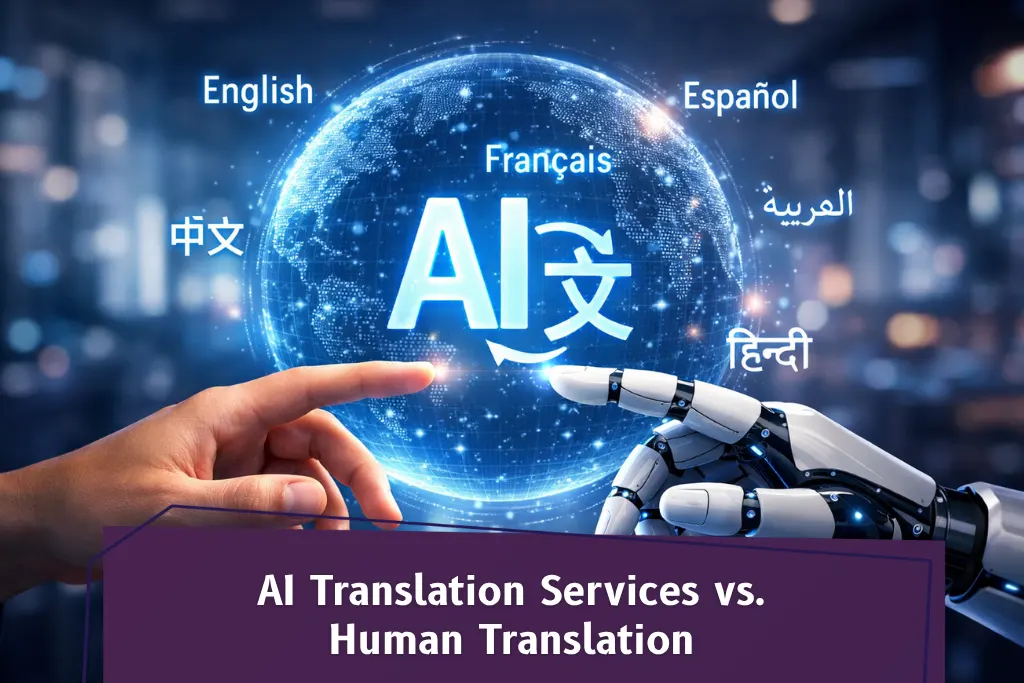
AI Translation Services vs. Human Translation in 2026: Which One Should You Choose?
In 2026, businesses and individuals choosing between AI translation services and human translation need to consider speed, scale, use case, and regulatory requirements. AI translation uses neural machine translation and advanced language tools to instantly translate text across multiple languages — delivering exceptional accuracy, workflow automation, and cost-efficiency at scale. Professional translation services complement AI by fulfilling specific regulatory and certification mandates for official documents. This blog breaks down both approaches — from high-volume multilingual communication to certified translations for official use — helping you build the right translation strategy for your business, whether you are a startup expanding globally or an enterprise managing multilingual content across dozens of markets. What Are AI Translation Services? How They Translate Text in 2026 Modern AI translation represents one of the most significant leaps in language services in decades. Powered by neural machine translation (NMT) and deep learning, today’s AI powered platforms can translate text between dozens of language pairs — Spanish, French, German, Italian, Portuguese, Japanese, Chinese, and many more — in seconds. Unlike basic consumer tools such as Google Translate, enterprise-grade AI translation services are purpose-built for professional use: they leverage translation memory to store and reuse previously approved translations, ensuring consistent terminology and brand voice across all documents and projects. These platforms allow teams to upload files, paste text, or integrate directly with a CMS or product pipeline for seamless workflow automation. With optional human review available as part of the translation process, businesses can configure exactly the level of oversight they need — balancing turnaround time, cost, and quality on a project-by-project basis. The result is a scalable, cost-efficient solution that removes language barriers at speed, empowering teams to publish multilingual content across global markets without delays or bottlenecks. What Is Human Translation — And How Do Professional Translators Complement AI? Human translation is performed by a professional translator who works alongside or after AI to provide cultural refinement, domain-specific expertise, and formal certification for content that requires it. In professional translation workflows, human translators review translated content for tone, contextual alignment, and terminology accuracy — adding a layer of quality assurance that is particularly valued in high-stakes communications and compliance-sensitive industries. More importantly, certain document types are governed by legal and governmental standards that require a qualified human signatory. Certified translations for immigration applications, academic credentials, court filings, and official government submissions must carry the certification of a qualified professional translator as mandated by the relevant authority. This is a regulatory distinction — a compliance requirement set by law — rather than a reflection of AI capability. For these document types, professional translators fulfill the formal certification role that official processes demand, making them a natural and essential part of a complete language services ecosystem. AI Translation vs. Professional Translation Services: Key Differences Understanding the role each approach plays helps businesses make smarter decisions about how to structure their translation process. Speed: AI translation services deliver near-instant results. Whether you need to translate a 10,000-word product catalog or a single web page, automated language services operate around the clock with consistent output and rapid turnaround time. Professional translators work within human capacity limits, making AI the clear choice for time-sensitive and high-volume projects. Cost: AI translation dramatically reduces per-word costs through automation, making large-scale multilingual content accessible even for growing teams. Professional translation services are typically engaged for specific content types or compliance workflows where a human signatory is required. Accuracy: Today’s AI translation services deliver exceptional accuracy across all major language pairs. Enterprise NMT platforms are trained on domain-specific data — covering legal, medical, technical, and marketing content — and use translation memory and glossary controls to maintain consistency across every project and language pair. Scalability: AI platforms scale effortlessly. Businesses managing multilingual communication across ten or twenty languages simultaneously can process entire content libraries in the time it would take a human team to handle a fraction of the volume. Certified Translations: For documents intended for official use, legal authorities and government bodies require certified translations carrying the formal attestation of a qualified professional translator. This is a regulatory standard set by governing institutions — and professional translators are the designated signatories for this purpose. When AI Translation Is the Right Choice (Including Expedited Service) AI translation is the ideal choice for the vast majority of business translation needs: Turnaround time is critical. An expedited service powered by AI can process thousands of words overnight, making it indispensable for global product launches, marketing campaign rollouts, or urgent website localization across multiple markets. Content volume is high. Blog posts, support documentation, product descriptions, e-commerce listings, and app interfaces all translate efficiently through AI at consistent quality and speed. Workflow automation drives your operations. Modern AI powered translation platforms integrate with content management systems, app repositories, and customer support tools — automating handoffs and eliminating delays in the translation process. Multiple languages are needed simultaneously. AI handles dozens of language pairs in a single project without proportionally increasing cost or delivery time, making it the backbone of any global content strategy. Optional human review fits your quality workflow. AI platforms with built-in optional human review give businesses the flexibility to add professional translators as a refinement layer for content that benefits from an additional pass — without sacrificing speed or efficiency. When Regulatory and Compliance Needs Call for Professional Translation Services and Certified Translations Certain content types are governed by institutional requirements that bring professional translators into the process — not as a substitute for AI, but as a compliance necessity: Certified translations for official use. Immigration applications, academic transcripts, court filings, and government documents require certified translations with formal attestation by a qualified professional translator, as mandated by the relevant legal or governmental authority. Legal and medical documentation for submission. For documents intended for official submission in the legal and healthcare industries, compliance protocols often specify that a qualified professional translator must certify the final output. MTPE workflows for compliance-grade content. Machine Translation Post-Editing combines AI’s speed with professional review, meeting institutional standards while keeping the translation process efficient and cost-effective. Creative and brand-sensitive