Nambix

Automated Transcription

ai transcription
Automated Transcription

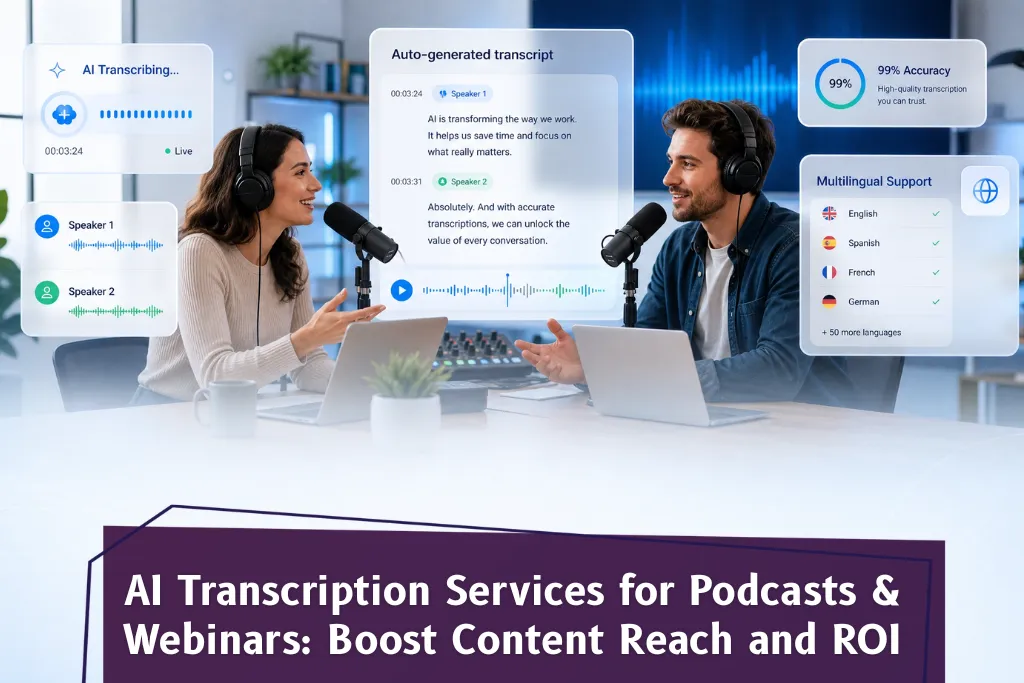
AI Transcription Services for Podcasts and Webinars: Boost Content Reach and ROI

AI transcription services for podcasts and webinars automatically convert spoken audio or video content into accurate, editable text — helping creators, marketers, and businesses unlock more value from every recording. Whether you run a weekly interview series, host live webinars, or produce a video podcast, AI transcription eliminates manual work, accelerates content repurposing, and makes your episode media fully searchable and accessible. This blog covers how AI transcription works for podcast and webinar content, why it outperforms manual transcription, and how to choose the right transcription service for your workflow. Why Podcast Creators Can’t Afford to Skip AI Transcription Every podcast episode you publish contains hours of valuable insight locked inside audio files. Without a full transcript, that content is invisible to search engines, inaccessible to deaf or hard-of-hearing listeners, and entirely dependent on playback — meaning your audience can’t skim, search, or share specific words. AI transcription solves all of this in minutes. You upload your podcast audio, and the system returns a high-quality transcript as a text file you can immediately use for blog posts, show notes, social media posts, or subtitles. What used to require a human transcriber and several hours now takes a fraction of the time — with comparable or better accuracy, especially at scale. For webinar hosts, the ROI case is even stronger. A single webinar recording can generate a complete transcript, short clips with captions, a searchable text archive for internal use, and repurposed content for YouTube and email — all from one upload. AI Transcription vs. Manual Transcription: What’s the Real Difference? Manual transcription involves a human listener transcribing spoken audio word by word. It’s time-intensive, expensive at scale, and impractical for long-form podcast episodes or multi-speaker webinar recordings. AI transcription, by contrast, uses speech recognition and machine learning to automatically transcribe audio in minutes. Modern systems handle different accents, multiple speakers, background noise, and varying audio quality with high accuracy. They support wav files, MP3s, video files, and more — making it easy to process any format you record in. The key advantages of AI over manual transcription: Speed: AI can transcribe hours of podcast audio in minutes, not days Cost: Dramatically lower per-minute cost, especially on paid plans with high volume Consistency: AI applies the same process to every file without listener fatigue Scale: Automatically transcribe an entire back-catalogue of podcast episodes at once Editability: Output arrives as editable transcripts you can refine before publishing The one area where human review still adds value is in catching domain-specific words or proper nouns — but AI handles the heavy lifting, leaving only light editing rather than full manual work. High Accuracy Transcription and How It Handles Different Accents One of the most common concerns about AI transcription is accuracy — particularly for podcasts featuring guests with different accents, non-native English speakers, or Spanish-language content. Early speech recognition tools struggled in these scenarios, but modern AI transcription engines are trained on diverse, multilingual audio datasets. Today’s best transcription services achieve high accuracy rates even with varied speaker accents, overlapping dialogue, and interview-style recordings where multiple voices speak in quick succession. For podcast hosts producing content in multiple languages, AI transcription now supports dozens of languages, making it viable for global audience reach. High accuracy matters not just for readability but for downstream uses: if you plan to extract quotes for social media posts or generate an SRT file for subtitles, small transcription errors compound quickly. Choosing a transcription service that prioritises accuracy from the beginning saves significant editing time. How AI Transcription Powers Content Repurposing The real ROI of podcast transcription isn’t just in having a text record — it’s in what that transcript unlocks for content repurposing. A single episode media file, once transcribed, becomes raw material for: Show notes: Pull key timestamps, topic summaries, and speaker highlights directly from your full transcript Blog posts: Restructure the podcast content into a long-form article without starting from scratch Social media posts: Extract quotes, statistics, and memorable moments from specific words in the transcript YouTube captions and subtitles: Convert the transcript into an SRT file and upload it directly Email newsletters: Use transcript excerpts to tease upcoming episodes or recap past ones Short clips: Identify the most compelling moments and clip them for Instagram Reels or YouTube Shorts For webinar hosts, a transcript also means complete searchability — anyone in your organisation can search for specific words or discussions from a session without rewatching the recording. This multiplier effect is what makes AI transcription a genuine growth tool rather than just a convenience. Free Podcast Transcription: What to Expect Many transcription platforms offer a free plan or free podcast transcription tier, which is useful for creators testing the process or working with occasional short clips. Free plans typically cover a limited file length per month, output a basic text file, and may have restrictions on file format — for example, only accepting MP3 and MP4 rather than wav files or other formats. For podcast hosts who publish weekly and need consistent, high quality transcripts with speaker labels, editable transcripts, and support for longer episode media, paid plans offer more features: higher monthly minutes, SRT file export, multi-language support, and integrations with podcast host platforms and YouTube. The decision between free and paid usually comes down to volume and intended use. If you plan to use podcast transcripts for SEO-driven blog posts or to improve listener experience with full transcripts on your website, a paid transcription service will deliver the accuracy and workflow features you need. Choosing the Right AI Transcription Service for Your Podcast When evaluating a transcription service, the key factors to assess are: accuracy across different accents and audio quality levels, support for your preferred file formats (including wav files and video files), output options (plain text, SRT file, editable transcripts), turnaround speed, and pricing structure for your episode volume. If your podcast content serves a global audience or includes interviews with non-native speakers, multilingual support becomes essential. If you’re focused on content repurposing, look for platforms that make it easy to edit, download, and

Smart Transcription Tools
Automated Transcription

How Smart Transcription Tools Help Make Online Learning More Engaging

Introduction As the digital classroom becomes the norm, engaging students in online education courses has never been more important. Whether it’s K–12 education online or university-level remote programs, clear communication and content accessibility are key. This is where smart transcription tools come into play. By leveraging automatic transcription software, educators and ed-tech platforms can improve learner engagement, increase accessibility, and enhance the overall learning experience. In this blog, we’ll explore how real-time transcription and audio-to-text solutions are revolutionizing remote learning, and why integrating transcription services online is a strategic move for any institution offering online learning. The Shift to Online Learning: Challenges and Opportunities The growth of remote learning and online education courses has opened doors for millions of learners across the globe. But this shift also comes with challenges—such as maintaining engagement, ensuring inclusivity, and catering to diverse learning preferences. Students learning from home often struggle with: Poor audio quality during live sessions Difficulty revisiting complex lessons Language or hearing barriers Lack of access to note-taking support This is where transcription academic solutions offer immense value. By transcribing live lectures or recorded materials, educational content becomes searchable, reviewable, and more digestible. What Are Smart Transcription Tools? Smart transcription tools are powered by AI and automatic speech recognition (ASR) technology. They work by converting voice to text—either in real-time or by processing pre-recorded audio and video files. Leading-edge automatic transcription software does more than just basic word capture. It can: Transcribe audio files with high accuracy Offer real-time transcription for live classes or webinars Convert audio and video into accurate, readable transcripts Support multiple speakers and distinguish between them Automatically add punctuation and formatting Transcribe YouTube videos to text, making learning videos more accessible Generate searchable transcription audio to text files for study material Work across multiple languages for global classrooms These tools integrate easily into LMS platforms, video conferencing tools, or custom ed-tech solutions. How Smart Tools Transcribe Audio to Improve Learning Outcomes Here’s how smart transcription tools make online learning more interactive and effective: 1. Improves Accessibility for Diverse Learners Not all students learn the same way. Some retain information better through reading rather than listening. Others may be non-native speakers or have hearing impairments. By offering transcription services online, institutions ensure every learner has equal access to course content. With audio-to-text files or subtitled video lectures, students can follow along more easily. 2. Supports Note-Taking and Revision Students no longer need to scribble down notes while trying to keep up. With the ability to transcribe audio, they can focus on understanding in real-time and return to the transcript later for review. This is especially helpful in K–12 education online, where attention spans can be shorter. 3. Boosts Retention Through Multimodal Learning Combining audio, visual, and text formats helps reinforce learning. Automatic transcription provides an additional layer of reinforcement, making it easier to absorb and retain information. 4. Facilitates Content Search and Organization Imagine a student trying to find a specific explanation in a 60-minute recorded lecture. With transcription audio to text, learners can search by keyword and jump directly to the relevant section—saving time and frustration. 5. Enables Reuse of Educational Content Transcripts of lectures, interviews, or discussions can be repurposed into study guides, blogs, quizzes, or reading material. This boosts content ROI for educators and enriches the learning ecosystem. The Transcription Process: From Audio File to Educational Value Modern transcription services follow a streamlined transcription process that begins with uploading an audio file—from a recorded lecture, podcast, or webinar. The automatic transcription software then processes the file, identifies speakers, applies contextual understanding, and delivers a structured transcript—sometimes in multiple languages. Educators can review and edit the transcript or integrate it directly into their online education courses. Whether you want to convert audio from YouTube videos or Zoom calls, smart tools simplify the process, even at scale. Why Educational Institutions Choose Smart Audio Transcription Solutions Here are a few reasons why transcription has become an essential part of modern remote learning: Speed & Scalability: AI-driven tools can transcribe audio files and video at scale—within minutes. Cost-Effective: Automated transcription services reduce reliance on manual efforts and significantly cut down operational costs. Consistency: Unlike manual note-takers, AI transcription maintains consistent output quality across large volumes of content. Multilingual Flexibility: Today’s students come from diverse linguistic backgrounds. AI transcription tools that support multiple languages enhance global reach. The Benefit of Online Education, Elevated with AI The biggest benefit of online education is flexibility. Students can learn anytime, anywhere, and at their own pace. When you add smart transcription to the mix, it further personalizes the learning journey by making every piece of audio or video content available in text form. For teachers, it means better content delivery. For institutions, it means better outcomes. For students, it means fewer barriers to understanding. Nambix: Your Partner in Smart Transcription for Online Learning At Nambix Technologies, we specialize in delivering high-accuracy automatic transcription solutions tailored for the education sector. Whether you’re looking to transcribe YouTube videos, convert audio into structured text, or implement real-time transcription for live sessions—we’ve got you covered. Our platform leverages advanced AI models to deliver: High-accuracy audio-to-text conversion Seamless integration into existing learning platforms Multiple language support Scalable transcription services online for institutions of any size Conclusion In an era where online learning is the new classroom, smart transcription tools are not just helpful—they’re essential. They enhance accessibility, improve engagement, and allow educators to deliver content in ways that meet the diverse needs of students. Whether you’re running a K–12 online program or managing global online education courses, investing in automatic transcription software is a step toward better learning outcomes. Ready to transform your digital classrooms? Explore how Nambix can help you transcribe audio, convert audio files, and redefine the benefit of online education with AI-powered transcription.

Automated Transcription

5 Ways Multilingual Chat Bots and Voice Bots are Transforming the Banking Industry

INTRODUCTION In the ever-changing banking industry, technological advancements are playing a crucial role in improving customer experiences. One of the most significant breakthroughs in recent times is the integration of multilingual chatbots and voicebots. These artificial intelligence-powered solutions are changing the way banks interact with their customers, offering personalized and efficient services across language barriers. In this blog, we will discuss five key ways in which multilingual chatbots and voicebots are revolutionizing the banking industry. MULTILINGUAL CHATBOTS & VOICEBOTS: An Essential Investment for Indian Bank Diverse Linguistic Landscape: India is a country with a diverse linguistic landscape, and many languages are spoken across regions. To effectively engage with a wide customer base, banks need to deploy chatbots and voicebots that can communicate in multiple languages. This ensures accessibility for customers across the country. Enhanced Customer Engagement:  Multilingual chatbots and voicebots facilitate more personalized and meaningful interactions with customers. When customers can communicate in their preferred language, it leads to better engagement, understanding, and overall satisfaction. Increased Customer Reach: By supporting various languages, banks can extend their services to a larger audience, including those who may not be proficient in English or Hindi. This inclusivity helps in reaching previously underserved or untapped customer segments. Multilingual chatbots and voicebots can handle a broader range of customer queries and issues without the need for human intervention. Competitive Advantage: Offering multilingual support sets banks apart in a competitive banking landscape. It demonstrates a commitment to understanding and serving the diverse needs of the customer base, potentially attracting new customers and retaining existing ones. Compliance with Regulations: Regulatory bodies may emphasize the need for financial institutions to provide services in multiple languages, especially in a diverse country like India. Investing in multilingual capabilities ensures that banks remain compliant with regulatory requirements. 5 Ways Multilingual Chat Bots and Voice Bots are Transforming the Banking Industry Enhanced Customer Engagement: In today’s globalized world, communication barriers can often hinder effective customer engagement. However, by utilizing multilingual chatbots and voice bots, banks can now engage with customers in their preferred language. This is particularly crucial for customers who speak diverse languages. By offering multilingual support, banks can create a more inclusive and personalized experience for their clients. Customers feel more comfortable and confident when they can communicate seamlessly in their native language. This leads to increased trust and satisfaction, ultimately resulting in stronger customer relationships.  Multilingual chatbots are created to comprehend and reply to natural language, which makes conversations feel more engaging and less robotic. This not only improves the overall customer experience but also motivates users to seek help more willingly, resulting in increased engagement. Whether a customer wants to check their account balance, transfer funds, or inquire about a specific transaction, multilingual chatbots offer a user-friendly interface that promotes positive interactions. Efficient Customer Support: Traditional customer support channels often result in long wait times and require the assistance of human agents. However, multilingual chatbots and voicebots provide a solution by offering instantaneous and round-the-clock assistance. These bots can handle routine queries, such as account inquiries, transaction history, and loan information, freeing up human agents to focus on more complex issues that require a personal touch.  The efficiency of multilingual chatbots stems from their ability to process and understand large volumes of data quickly. They can analyze customer queries, identify patterns, and deliver relevant responses swiftly. This not only streamlines customer support processes but also reduces operational costs for banks, making them more agile and responsive in addressing customer needs. Personalized Financial Advice: Multilingual chatbots and voicebots can provide personalized financial advice, which is one of their most compelling features. These AI-driven solutions can analyze a customer’s financial history, spending patterns, and goals to offer tailored recommendations. They can suggest budgeting strategies, investment opportunities, and savings plans, providing valuable insights to help customers make informed financial decisions.  By offering personalized advice in multiple languages, banks can cater to the diverse needs of their customer base. This level of customization not only enhances the customer experience but also fosters a sense of trust and loyalty. Customers appreciate financial institutions that understand their unique circumstances and offer guidance that aligns with their individual goals. Streamlined Onboarding and Account Management: Multilingual chatbots can make the onboarding process for new customers and account management for existing ones more efficient. They can assist users with the account creation process, guide them through necessary documentation, and answer any queries. This streamlined onboarding experience not only enhances customer satisfaction but also accelerates the overall account creation process.  For existing customers, multilingual chatbots are great at helping with account management tasks, such as updating personal information, setting up account alerts, and managing card preferences. Having a virtual assistant that speaks the customer’s language makes these processes more accessible and user-friendly, contributing to a positive customer experience. CONCLUSION Multilingual chatbots and voicebots are transforming the banking industry by providing enhanced customer engagement, efficient support, personalized financial advice, robust security measures, and streamlined onboarding and account management. As banks continue to embrace these AI-driven solutions, they position themselves to meet the diverse needs of their global customer base while reaping the benefits of improved efficiency, cost savings, and heightened customer satisfaction. The integration of multilingual chatbots and voice bots is not just a technological upgrade; it’s a strategic move that propels the banking industry into a new era of customer-centric innovation.

Automated Transcription

The Rise of Multilingual Banking in India

INTRODUCTION India, a diverse nation with a myriad of languages and cultures, has witnessed a remarkable transformation in its banking sector in recent years. The rise of multilingual banking is not just a trend but a necessity in a country where linguistic diversity is a way of life. As the banking industry embraces this change, it not only caters to the linguistic preferences of its customers but also opens up new avenues for financial inclusion. In this blog, we will explore the factors driving the rise of multilingual banking in India and the impact it has on the financial landscape. Linguistic Diversity in India India boasts a linguistic tapestry that is as rich and varied as its cultural heritage. With 22 officially recognized languages and with over 19500 dialects spoken across the country, catering to the linguistic preferences of the populace is a complex challenge. English and Hindi may be the official languages at the national level, but a significant portion of the population feels more comfortable communicating in their regional languages. This linguistic diversity has often posed a barrier in various sectors, including banking, where communication is crucial. Recognizing the need to bridge this linguistic gap, banks are increasingly adopting a multilingual approach to connect with a wider audience. Digital Transformation in Banking The advent of digital technology has played a pivotal role in shaping the future of banking in India. The government’s push for a digital economy through initiatives like Digital India and the rapid proliferation of smartphones has led to a surge in online transactions. As a result, banks are now leveraging technology to provide seamless and user-friendly interfaces for their customers. In this digital era, the importance of language-friendly interfaces cannot be overstated. A multilingual approach in banking apps and websites ensures that users can navigate through various services in the language they are most comfortable with. This inclusivity enhances the overall user experience and encourages more people to participate in the formal financial sector. Financial Inclusion through Vernacular Banking One of the primary benefits of embracing multilingual banking is the promotion of financial inclusion. Historically, a significant portion of the Indian population, especially in rural areas, has been excluded from the formal banking system due to language barriers and a lack of understanding of financial products. Multilingual banking addresses this issue by making banking services accessible to a broader demographic. By offering banking services in regional languages, financial institutions can effectively communicate the nuances of various products and services. This, in turn, empowers individuals to make informed decisions about their finances. From opening a bank account to applying for loans or understanding investment options, vernacular banking makes these processes more transparent and comprehensible. Customer Engagement and Trust Building trust is a critical aspect of banking, and language plays a significant role in establishing that trust. When banks communicate with customers in their native language, it creates a sense of familiarity and comfort. Customers are more likely to engage with a bank that understands and respects their linguistic preferences. Multilingual customer support adds another layer to this trust-building process. Prompt and efficient customer service in regional languages not only resolves issues effectively but also strengthens the bond between the customer and the bank. As a result, customers feel more valued, leading to increased loyalty and satisfaction. The Future of Multilingual Banking The future of multilingual banking is likely to be shaped by technological advancements, changing customer expectations, and a globalized financial landscape. Here are some potential trends and developments that could define the future of multilingual banking: AI-Powered Language Support: Integration of advanced artificial intelligence (AI) and natural language processing (NLP) technologies to enhance multilingual customer support. Chatbots and virtual assistants are capable of understanding and responding in multiple languages, providing seamless assistance to customers from diverse linguistic backgrounds. Language-agnostic Interfaces: Development of banking interfaces that are language-agnostic, allowing users to interact in their preferred language without the need for specific translations. User interfaces that adapt dynamically to different languages, making banking services more accessible and user-friendly for a global customer base. Localization of Financial Services: Tailoring financial products, services, and marketing strategies to specific linguistic and cultural preferences in different regions. Customized user experiences that consider local language nuances and cultural differences to build trust and resonate with customers. Blockchain and Cross-Border Transactions: Utilization of blockchain and distributed ledger technologies to facilitate cross-border transactions, overcoming language barriers and ensuring transparent, secure, and efficient global financial transactions. Smart contracts that support multilingual terms and conditions, automating and standardizing agreements across diverse linguistic environments. Multilingual Data Analytics: Integration of advanced analytics tools capable of processing and analyzing multilingual data to gain insights into customer behavior, preferences, and market trends. Utilization of multilingual sentiment analysis to understand customer feedback across different languages, enabling banks to improve services based on global customer sentiments. CONCLUSION The rise of multilingual banking in India signifies a progressive step towards financial inclusivity and customer-centricity. By breaking down language barriers, banks are not only expanding their customer base but also contributing to the larger goal of fostering a financially literate society. As technology continues to play a pivotal role in shaping the banking landscape, the focus on linguistic diversity ensures that the benefits of the digital revolution reach every corner of the country. Multilingual banking is not just about transactions; it’s about creating meaningful connections and empowering individuals to navigate the complexities of the financial world in the language they understand best.  

Automated Transcription, Machine Translation

5 Reasons Your Website Needs a Multilingual Voice Bot

In today’s digital age, communication has become the foundation of our interconnected world. As technology continues to break down barriers and connect people across the globe, the way we communicate has undergone a significant transformation. With the rise of instant messaging, video calls, and virtual interactions, the importance of seamless and effective communication has become more vital than ever before. One remarkable advancement in this digital revolution is the advent of multilingual voice bots. These sophisticated conversational agents have revolutionized the way businesses and individuals interact and have become an indispensable tool in enhancing the overall user experience. Picture a digital assistant capable of understanding and responding in multiple languages, seamlessly bridging linguistic gaps, and enabling a truly global conversation. Multilingual voice bots are not just a tool; they are a marvel of technology, poised to redefine the way we engage with the digital realm. In this exploration, we delve into the significance of multilingual voice bots, unraveling their pivotal role in shaping a more inclusive and accessible digital communication landscape. Join us on this journey as we unravel the threads of innovation, connectivity, and linguistic diversity that make multilingual voice bots a key player in the contemporary era of communication. What is a Voice Bot? A multilingual voice bot is an advanced technology designed to enable natural language communication between users and a website or application. Unlike traditional chatbots, which rely on text-based interactions, multilingual voice bots use speech recognition and synthesis to understand and respond to spoken language. These bots are programmed to comprehend various languages, making them suitable for a diverse user base. How do they work? 1) Speech Recognition: Multilingual voice bots use sophisticated algorithms to convert spoken words into text, enabling them to accurately understand user queries. 2) Natural Language Processing (NLP): NLP algorithms analyze the text to understand the user’s intent, extracting meaning from phrases and context to provide relevant responses. 3) Language Translation: To provide multilingual capabilities, these bots are equipped with language translation features, allowing them to understand and respond in multiple languages. 4) Speech Synthesis: Once the bot has processed the input, it uses speech synthesis technology to convert its responses back into spoken language, creating a natural and interactive conversation. 5 Reasons Your Website Needs a Multilingual Voice Bot 1. Enhanced User Experience:User experience (UX) is at the forefront of website success. A multilingual voice bot takes user interaction to a whole new level by providing a natural and intuitive way for visitors to engage with your website. Unlike traditional text-based interfaces, voice bots allow users to communicate effortlessly using their voice. This is particularly beneficial for users who struggle with typing, have language barriers, or prefer a hands-free approach. Imagine a potential customer visiting your website from a non-English-speaking country. Instead of navigating through pages written in a language they may not fully understand, they can interact with the voice bot in their native language. This not only simplifies the user journey but also makes your website more welcoming and accessible to a global audience, ultimately leading to higher user satisfaction. 2. Increased Accessibility:Accessibility is a key aspect of web design, and a multilingual voice bot contributes significantly to making your website more inclusive. People with disabilities, such as visual impairments or motor skill limitations, often face challenges when interacting with websites. A voice bot provides an alternative means of interaction, allowing users to navigate, search, and obtain information without relying solely on visual or manual inputs. Moreover, a multilingual voice bot supports users with literacy challenges, providing them with a spoken interface that can be more comfortable and effective than reading. By prioritizing accessibility, your website complies with ethical standards and opens doors for a wider audience, including those who may have been previously excluded. 3. Global Reach and Market Expansion:The internet has turned the world into a global marketplace. To tap into international markets successfully, it’s crucial to communicate with customers in their preferred language. A multilingual voice bot breaks down language barriers, enabling your website to reach a diverse and global audience. Consider the scenario of an e-commerce website offering a range of products. By implementing a multilingual voice bot, customers from different countries can comfortably browse products, inquire about features, and make purchases in their native language. This not only broadens your customer base but also positions your brand as one that values and respects cultural diversity.Additionally, a multilingual voice bot can assist in overcoming linguistic challenges during customer support interactions. Resolving queries in the customer’s preferred language fosters a positive relationship and builds trust, key elements for customer satisfaction and retention. 4. Competitive Advantage:In a competitive digital landscape, standing out from the crowd is essential. Integrating a multilingual voice bot sets your website apart by demonstrating innovation and a commitment to providing an exceptional user experience. While many websites still rely solely on text-based interfaces, incorporating a voice bot showcases a forward-thinking approach to technology. Customers are more likely to engage with websites that offer convenience and a personalized experience. A multilingual voice bot not only caters to diverse linguistic preferences but also adapts to individual user interactions. This level of personalization can be a game-changer, influencing visitors to choose your website over competitors and fostering brand loyalty. Furthermore, in industries where customer support plays a pivotal role, a multilingual voice bot can significantly reduce response times, providing instant assistance and elevating the overall customer service experience. This competitive edge can be a decisive factor in attracting and retaining customers in a global market. 5. Adaptation to Changing Technology Trends:Technology is constantly evolving, and staying ahead of the curve is crucial for the long-term success of your website. Voice technology is experiencing rapid growth, with virtual assistants becoming increasingly integrated into daily life. By incorporating a multilingual voice bot, your website aligns with current technology trends and prepares for the future. Voice search, in particular, is gaining popularity, and optimizing your website for voice interactions can enhance its visibility in search engine results.

Automated Transcription

The Role of Machine Learning in Automated Translation and Captioning

Machine learning (ML) is increasingly important in automated translation and captioning. ML-powered translation systems can now translate text and speech from one language to another with high accuracy. They can also generate captions for videos and other multimedia content. Here are some of the ways that ML is being used in automated translation and captioning: ML-powered translation and captioning systems are still under development but have already made significant progress. These systems will become even more accurate and efficient as ML technology improves. Here are some of the benefits of using ML in automated translation and captioning: However, it is essential to note that ML-powered translation systems could be better. They can sometimes make mistakes, mainly when translating complex or idiomatic language. Therefore, it is necessary to proofread ML-generated translations carefully before using them. Overall, ML is playing an increasingly important role in automated translation and captioning. ML-powered translation systems are becoming more accurate, faster, and more scalable. As ML technology improves, these systems will become even more widely used.

Scroll to Top