
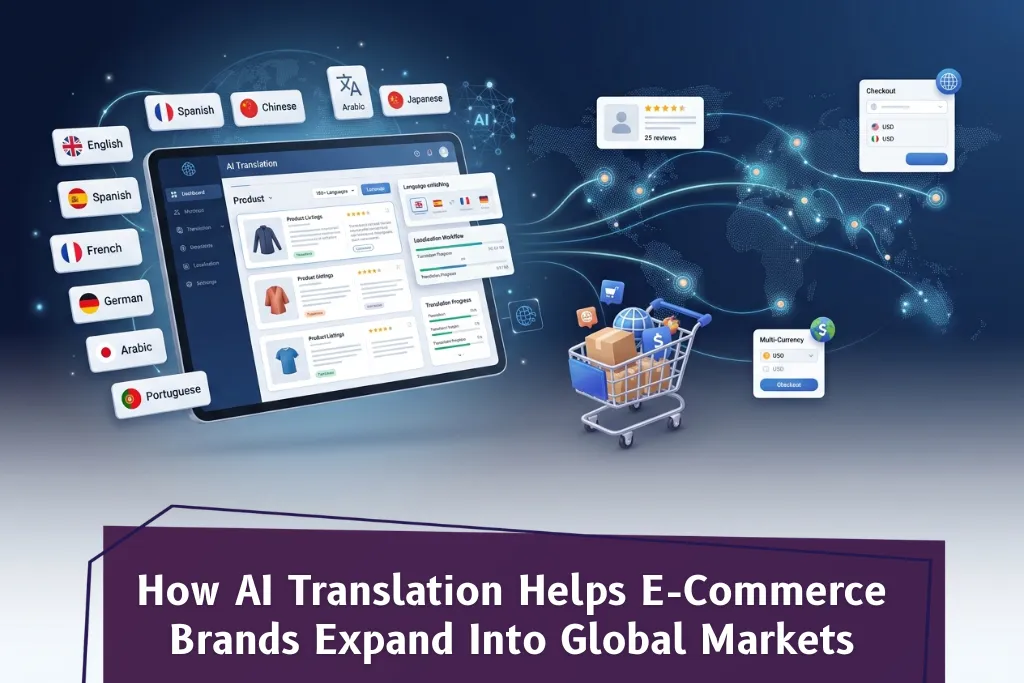
AI translation helps e-commerce brands expand into global markets by converting product pages, marketing copy, and customer support content into a target market’s local language quickly, accurately, and at scale, using neural machine translation combined with human review to preserve cultural nuances, tone, and brand consistency. For an e-commerce business internationally, this means faster market entry, improved multilingual SEO, and a shopping experience that feels native to international customers rather than translated. Below, we break down exactly how AI translation for e-commerce works, the localization challenges it solves, and how to use it to grow your online store across multiple markets.
What Is AI Translation for E-Commerce?
AI translation for e-commerce refers to the use of machine translation engines, trained on large volumes of multilingual content, to convert product descriptions, category pages, checkout flows, and marketing materials from one language to another. Unlike older rule-based systems, modern AI-powered translation tools understand context, so they don’t just translate words individually — they interpret meaning across the entire sentence and adapt it for the target language.
For an e-commerce site looking to expand globally, this matters because 76% of online shoppers prefer to buy products with information in their native language. If your e-commerce website only speaks one language, you’re closing the door on a global marketplace full of ready buyers. AI translation opens that door by making your catalog accessible in the local language of every market you want to reach.
Why E-Commerce Translation Matters for Global Growth
E-commerce translation isn’t just about swapping words — it’s a growth strategy. Data consistently shows that companies prioritizing translation are 1.5 times more likely to increase revenue than those that don’t. Buyers are 13% more likely to purchase from stores that have been translated into their own language, and 76% of consumers prefer websites translated into their language over an English-only version. In fact, 60% of consumers rarely buy from English-only websites at all, no matter how strong the product is.
This is where AI translation enables faster market entry for e-commerce businesses. Instead of spending months manually translating thousands of SKUs, AI translation tools can process large volumes of product descriptions, FAQs, and marketing copy in days, giving your e-commerce business internationally the ability to launch in new markets on a realistic timeline. Automated translation processes can cut turnaround time by 50%, and AI in e-commerce translation can reduce costs by up to 40% compared to fully manual translation workflows.
Key E-Commerce Localization Challenges
Every e-commerce localization project runs into a similar set of challenges: maintaining consistency across thousands of pages, adapting currencies and units, keeping multilingual SEO metadata accurate, and avoiding literal, word-for-word translations that confuse shoppers. Inaccurate translations on a product page can quietly drive customers away — a mistranslated size guide or a clumsy checkout instruction is often enough to lose a sale.
AI translation tools address these e-commerce localization challenges directly. A well-built translation workflow uses translation memory to keep terminology and phrasing consistent across your entire e-commerce platform, so a product name or feature description is described the same way whether it appears on the homepage, in an email, or in a chatbot response. This consistency is difficult to maintain manually once your catalog grows into the thousands, but it’s a natural strength of AI translation at scale.
How AI Translation Solves Cultural Nuances in E-Commerce
Language is only part of the equation — cultural nuances are what make a translated page feel authentic rather than robotic. Modern AI translation adapts tone and cultural references rather than relying on direct translations that are translated literally from the source. A promotional line that works in one country might feel out of place in another, and AI translation tools are increasingly capable of picking up on cultural context and cultural preferences to reframe marketing copy appropriately for each target audience.
This extends to product descriptions, imagery captions, and even user generated content like reviews, which can be translated and lightly adapted so international customers reading reviews in their own language get the same trust signals as shoppers browsing in the original language. When AI translation is paired with quality assurance and human review, businesses get the speed of automated translation with the polish that a target market expects.
Localizing Your E-Commerce Platform and E-Commerce Site
Translating text is only one part of expanding your e-commerce platform into a new region. A fully localized e-commerce site also needs multi language support built into navigation, filters, and search, along with structured data and meta descriptions translated for each locale to support international search engines. AI translation tools now offer direct integration with popular e-commerce platforms, allowing product feeds, category pages, and dynamic UI elements to be translated automatically as new inventory is added.
This kind of direct integration matters because manually updating a multilingual e-commerce website every time a product is added or a price changes isn’t sustainable. Automated translation pipelines keep your e-commerce store synchronized across every local language version, so customers always see current, accurate information no matter which market they’re shopping from.
SEO Optimization and Multilingual SEO for Global Markets
Reaching new markets isn’t only about having translated content — it’s about being found. Multilingual SEO requires localized keyword research for each market, since shoppers in different countries often search using different terms even when searching for the same product. AI translation tools help manage multilingual SEO metadata, including page titles, meta descriptions, alt text, and URLs, which improves visibility on international search engines.
Localized metadata improves search rankings in different languages, turning a translated page into one that actually drives organic traffic — without it, even a well-translated e-commerce website can stay invisible to shoppers searching in their own language.
Boosting Customer Engagement and Customer Satisfaction
The customer journey looks very different when a shopper can browse, read reviews, and check out entirely in their own language. Personalized experiences — including localized product recommendations and marketing copy — boost customer engagement and trust, and translated content that reflects local buying habits leads directly to higher customer satisfaction. Even something as simple as displaying prices in local currency has measurable impact: e-commerce sites using localized currencies can increase conversion rates by 40%.
AI translation also helps brands avoid one of the most damaging localization mistakes: presenting content in the wrong language to the wrong audience, or defaulting an entire regional storefront to one language when the target market expects several. Getting this right builds the kind of trust that turns first-time visitors into repeat international customers.
AI Translation and Customer Support for Your E-Commerce Store
Support doesn’t stop once a sale is made, and language barriers shouldn’t either. AI can provide instant multilingual customer support via chatbots, answering common questions in a customer’s native language at any hour, across any time zone. For an e-commerce store operating across multiple markets, this kind of scalable customer support is difficult to deliver with human agents alone, but AI translation makes it achievable without sacrificing responsiveness.
Machine Translation and Post-Editing (MTPE) also plays a role here, speeding up the translation of support documentation, return policies, and FAQs so customers always have access to accurate information in their own language, reducing friction and support tickets alike.
Maintaining Brand Consistency Across Global Markets
As an e-commerce business internationally, your brand voice needs to feel consistent whether a customer is reading your homepage, a product description, or a support chat, in any language. Translation memory and structured translation workflows help maintain brand consistency by reusing approved terminology and phrasing across every translated page, so your marketing strategies land the same way in every market.
Effective e-commerce translation reduces purchasing friction and builds trust precisely because it maintains this consistency while still adapting to local language expectations. That balance — consistent brand identity, locally adapted delivery — is what separates a translation that converts from one that simply exists.
Getting Started: AI Translation for Your E-Commerce Business
Expanding an e-commerce business into new, multiple markets no longer requires choosing between speed and quality. AI translation tools, backed by structured translation services, allow brands to launch multilingual websites quickly, keep multilingual content accurate and on-brand, and continuously optimize for multilingual SEO as they scale into new regions.
Nambix Technologies builds AI-powered translation solutions specifically for e-commerce brands, combining automated translation with quality assurance workflows to help online stores expand globally without sacrificing accuracy or brand voice.
Frequently Asked Questions (FAQs)
1. How does AI translation help e-commerce businesses reach international customers?
AI translation for e-commerce converts product descriptions, marketing copy, and support content into a shopper’s native language quickly and at scale, which matters since 76% of consumers prefer websites translated into their language. Nambix Technologies offers AI-powered translation solutions built specifically for e-commerce catalogs, helping brands reach international customers without slowing down product launches.
2. What is the difference between machine translation and AI translation for e-commerce?
Machine translation refers to any automated conversion between languages, while modern AI translation goes further by understanding context, tone, and cultural nuances rather than producing direct translations word for word. Nambix Technologies uses advanced neural machine translation models paired with quality assurance steps to deliver high quality translations tailored to e-commerce content.
3. Can AI translation handle multilingual SEO for an e-commerce website?
Yes — AI translation tools can translate metadata, URLs, and structured data alongside visible page content, which supports multilingual SEO and improves visibility on international search engines. Nambix Technologies incorporates SEO optimization into its translation workflow, helping e-commerce sites gain organic traffic in every target market they enter.
4. How much can AI translation reduce localization costs for e-commerce stores?
AI translation can reduce localization costs by up to 40% compared to traditional manual translation processes, while also cutting turnaround time significantly. Nambix Technologies is designed to deliver this same cost and speed advantage, letting e-commerce businesses localize large catalogs without stretching budgets or timelines.
5. Does AI translation account for cultural nuances in product descriptions?
Modern AI translation adapts tone, phrasing, and cultural references so product descriptions feel natural to the target audience rather than literally translated. Nambix Technologies builds cultural context into its translation workflow, ensuring marketing copy and product pages resonate with local shoppers in each target market.
6. How does AI translation improve customer engagement on e-commerce platforms?
Personalized, localized experiences — including native-language product pages and support — boost customer engagement and trust, leading to a smoother customer journey and higher conversion rates. Nambix Technologies helps e-commerce platforms deliver this level of localization across multiple markets, from product content to multilingual customer support.
7. Can AI translation support multilingual customer support for e-commerce stores?
Yes — AI translation enables instant multilingual customer support through chatbots and translated help documentation, so customers get answers in their own language without delays. Nambix Technologies offers AI-driven support translation solutions that help e-commerce stores scale customer service across global markets efficiently.
