
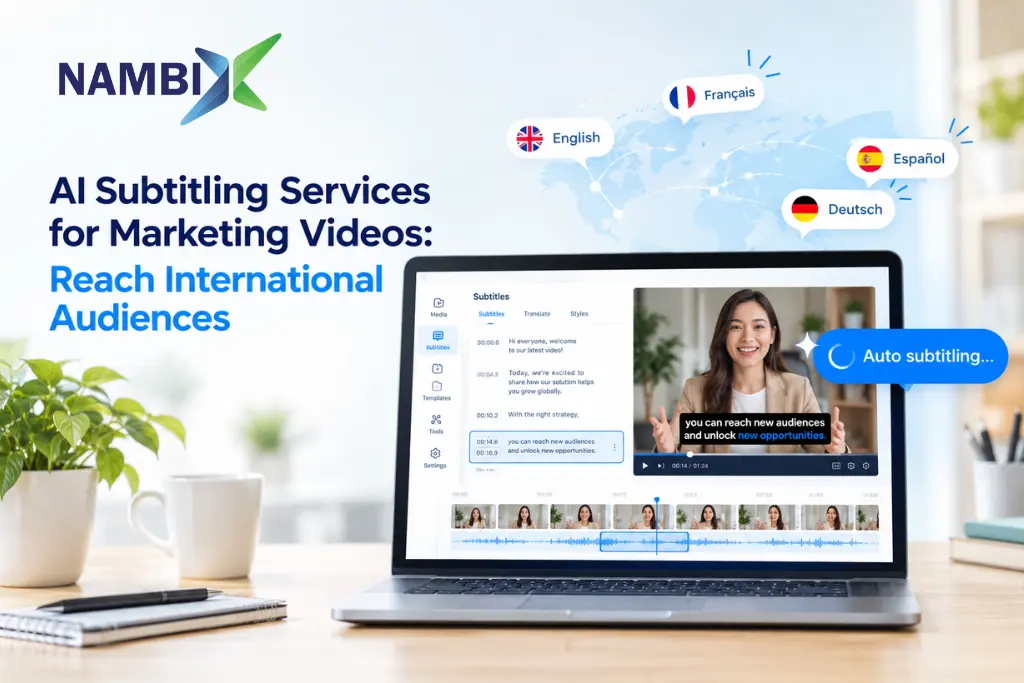
AI Subtitling Services for Marketing Videos: Reach International Audiences
Video subtitling services use an AI subtitle generator to auto generate subtitles from a video’s audio track, then sync, format, and export them as a subtitle file a marketing team can publish on any platform. For brands shooting one video and wanting it to land with audiences in a dozen languages, this is the difference between a single-market asset and a video that actually reaches a global audience. Nambix Technologies builds AI-powered subtitling tools for marketing teams who need accurate subtitles fast, with human review available wherever a campaign calls for it.
Why Subtitles Are No Longer Optional for Marketing Video
Most marketing video is watched on mute by default. An estimated 85% of videos on mobile are watched without sound, whether a viewer is scrolling a feed at work, on transit, or anywhere audio would be intrusive. A video without subtitles loses its message in that moment, no matter how strong the creative is. Subtitles close that gap directly: industry research on captioned video ads has found subtitles boost viewer retention by wide margins, with one widely cited study putting the lift as high as 80% for finishing a video, and subtitles improve viewer retention specifically on mute-first feeds where sound is rarely turned on.
The engagement case is just as strong. Subtitles increase engagement on social media by a meaningful margin in most platform studies, and videos with subtitles are considerably more likely to be shared than videos without them, since a subtitled clip works in more contexts, on a bus, in a waiting room, in an open office, than one that depends on sound. For a marketing team measuring watch time, shares, and completion rate, adding subtitles is one of the highest-leverage, lowest-cost changes available.
What Video Subtitling Services Actually Do
Video subtitling services convert spoken audio into text and time it to match the video, producing a subtitle file, most often an SRT or VTT file, that can be attached to the video, burned in, or published separately for platforms that read captions directly. An AI subtitle generator does the heavy lifting on this first pass: automatic speech recognition converts the audio file into a transcript, and an auto subtitle generator then breaks that transcript into properly timed subtitle lines, adjusting for pacing so each line stays on screen long enough to read.
Subtitles and closed captions are often used interchangeably, but they are not identical. Subtitles primarily display spoken dialogue for viewers who understand the audio but not the language, while closed captions include dialogue and important sounds, such as music cues or sound effects, to improve accessibility for viewers who cannot hear the audio at all. A marketing video aimed at an international audience typically needs subtitle translations into each target language; a marketing video aimed at accessibility compliance needs closed captions in the original language as well.
Open vs. Closed Captions: Hardcoded Subtitles and Platform Behavior
Hardcoded subtitles are burned permanently into the video file itself, so they display on every platform regardless of whether that platform supports a separate caption track, which makes them the safer default for marketing videos shared across multiple channels. Closed captions, by contrast, live in a separate subtitle file or data track and can be toggled on or off by the viewer, which works well on platforms like YouTube that read an uploaded SRT file natively but less reliably on platforms that strip caption tracks during upload.
When to Add Captions Instead of Subtitles
A marketing team should add captions, rather than plain subtitles, whenever a video needs to meet accessibility requirements or is likely to be watched by deaf or hard-of-hearing viewers, since captions carry sound cues that subtitles leave out. For a purely international-reach use case, such as translating an English-language ad into Spanish, subtitles alone are usually sufficient.
How to Add Subtitles and Auto Generate Subtitles: The Workflow Marketing Teams Use
Most AI subtitling tools follow a consistent sequence, whether the source is a product demo, a testimonial, or a 15-second social ad.
| Step | What Happens | Typical Output |
| Upload | Upload your video or audio file to the subtitle generator | Audio track extracted for processing |
| Generate | Automatic speech recognition converts speech to text and adjusts timing | Draft subtitle file, usually SRT |
| Edit | Review and edit subtitles in an online subtitle editor for accuracy | Corrected subtitle line breaks and spelling |
| Style | Apply subtitle font, size, color, and position to match brand visual elements | Styled subtitles ready for export |
| Translate | Optional subtitle translations into target languages using AI or native speakers | Multilingual subtitle files |
| Export | Download the finished subtitle file or export captions directly into the video | SRT, VTT, or TXT file, or a captioned video file |
How to Edit Subtitles and Style Them Before Publishing
Even an accurate first-pass transcript usually needs a short editing pass. An online subtitle editor lets a marketer adjust timing, fix misheard names or product terms, and break long lines so captions stay readable on a small screen. Subtitle style matters more for marketing video than for internal content: subtitle font, size, color, and background all affect whether captions read as a polished brand element or a distraction, and many teams default to a clean sans-serif font with a semi-transparent background so captions stay legible over bright or busy footage.
Accurate Subtitles: What to Expect from an AI Subtitle Generator
Accurate subtitles are the entire point of a subtitling service, so accuracy is the first thing to evaluate. Automatic Speech Recognition is often combined with human review for high accuracy, and the best AI subtitling tools now reach accuracy well above 95% on clear audio with standard accents, with some platforms advertising up to 99% accuracy enhances viewer comprehension on top-quality source recordings. High transcription accuracy reduces editing time significantly and improves the viewer experience, since fewer corrections means a faster path from upload to a published, perfectly synced video.
Auto Subtitle Generator Accuracy on Real Marketing Footage
An auto subtitle generator performs best on a clean voiceover or a single speaker talking directly to camera, which covers a large share of marketing video, product demos, testimonials, founder-led ads, and explainer content. Background music, overlapping speakers, or a noisy filming location will still push accuracy down, which is exactly the gap a quick human editing pass is meant to close before a video goes live.
Accuracy drops with background noise, overlapping dialogue, strong accents, or industry-specific terminology, which is exactly where quality control in subtitling matters most. Quality control checks for accuracy, timing errors, and readability before a subtitle file ships, catching the kind of mismatched sync or garbled line that undermines an otherwise strong marketing video. Human subtitling services are better for complex content such as multiple speakers and legal material, so Nambix pairs its AI subtitle generator with optional human review for campaigns where getting every word exactly right matters more than speed.
Reaching a Global Audience with Subtitles in Multiple Languages
Subtitles make content accessible in over 100 languages when a subtitling service supports a broad multilingual pipeline, which turns one piece of marketing video into dozens of localized assets without reshooting anything. For multilingual subtitling projects, it helps to choose services with experienced linguists for target languages rather than relying on raw machine translation alone, since idiom, humor, and brand tone rarely translate literally. The subtitling process can include optional translation into target languages using native speakers or AI, and most marketing teams use AI for the first draft and native speakers for final review on flagship campaigns.
This matters because the payoff is real: a product demo translated into five languages reaches five markets’ worth of new audiences from a single shoot, and English subtitles alone can meaningfully widen a video’s reach even in English-speaking markets, since a large share of viewers, including non native speakers and viewers with hearing differences, prefer or require subtitles to follow dialogue clearly.
Choosing Between AI Subtitling Tools and Human-Based Services
Different subtitling services offer various features, support for multiple languages, editing capabilities, and turnaround speed, and the right choice usually comes down to the content itself.
| Factor | AI Subtitling Tools | Human-Based Subtitling Services |
| Speed | Minutes per video; near-instant first draft | Hours to days, depending on complexity |
| Cost | Lower cost, scales across many videos and languages | Higher cost, priced per minute of video |
| Best for | High-volume social and marketing content, product demos, quick turnarounds | Legal, broadcast, or multi-speaker content needing precision |
| Accuracy on clear audio | 95%+ with modern AI tools | 99%+ with professional review |
| Accuracy on noisy or accented audio | Drops meaningfully without review | Holds steady with trained linguists |
Choosing a subtitling service depends on prioritizing accuracy, speed, or cost for the specific video in question. Reliable video subtitling services include AI-driven platforms for volume and premium human-based services for precision, and many marketing teams use both: AI tools are faster and cheaper for everyday content, while a professional workflow with human review covers hero campaigns, product launches, and anything where accuracy is non-negotiable.
Subtitles and Video SEO: Why Caption Files Help Content Get Found
Subtitles help videos appear in more searches because search engines cannot watch a video, but they can read a transcript. Adding subtitles, and publishing the resulting transcript in video descriptions, gives search engines indexable text tied directly to the video, which can boost video SEO for marketing content competing for attention in crowded search results. This is a secondary benefit rather than the main reason to subtitle a video, but it compounds over time as a library of subtitled, transcribed marketing videos accumulates searchable text that a video with no captions simply doesn’t have.
What to Look For in Video Subtitling Services
Marketing teams evaluating subtitling services for a growing video library should check for a specific set of capabilities before committing to a tool.
- Language coverage: support for the specific target languages a campaign needs, not just a generic claim of multiple languages.
- Export flexibility: the ability to download an SRT, VTT, or TXT file, or export captions directly burned into the video.
- Editing tools: a built-in subtitle editor to adjust timing, fix text, and edit subtitles without needing a separate app.
- Styling control: control over subtitle fonts, size, color, and position so captions match a brand’s visual elements.
- Human review option: a path to professional review for flagship content where accuracy is critical.
- Platform compatibility: export formats that work across the platforms a brand actually publishes to, since not every platform handles captions the same way.
Many subtitling services let a content creator create video subtitles and automatic subtitles from raw audio files in a single pass, often with a free tier for short clips before a paid plan is needed. Publishing visual content with auto captions already attached keeps the video accessible to a wider audience from the first view, and a seamless experience across upload, edit, and export keeps users moving quickly instead of juggling separate tools for each step.
How Nambix Supports AI Subtitling for Marketing Teams
Nambix Technologies positions AI as fully capable of handling the volume of everyday marketing video subtitling, with human expertise available as an optional layer rather than a required correction step. Nambix’s AI Subtitling Services, built on its vSubtitle product, support 100+ languages, up to 99.5% accuracy on clear audio, and export in SRT, VTT, and TTML, so a marketing video can move from upload to published, multilingual subtitle file in minutes rather than days.
Nambix’s subtitling work sits alongside its broader language technology stack: AI Captioning Services for accessibility-focused content, AI Translation Services for everything beyond the video itself, and Machine Translation Post-Editing (MTPE) for campaigns where human review earns its cost. Nambix serves marketing teams across e-commerce, technology, and other industries. To scope a subtitling workflow for your next campaign, get in touch with Nambix.
Ready to make your next marketing video land with audiences everywhere? Explore Nambix AI Subtitling Services or get in touch to scope a subtitling workflow for your video library.
Frequently Asked Questions (FAQs)
1. What are video subtitling services?
Video subtitling services convert a video’s spoken audio into timed, synced text, delivered as a subtitle file such as SRT or VTT, so viewers can follow along without sound or in a language other than the video’s original audio. Nambix provides AI-powered video subtitling services built for marketing teams that need fast, accurate subtitles across many videos and languages.
2. How does an AI subtitle generator work?
An AI subtitle generator uses automatic speech recognition to convert spoken audio into text, then times each line to match the video before exporting a subtitle file a creator can edit and publish. Nambix’s auto subtitle generator pairs this automated first pass with an online subtitle editor so marketing teams can refine wording and timing before a video goes live.
3. What is the difference between subtitles and closed captions?
Subtitles display spoken dialogue for viewers who understand the audio but not the language, while closed captions also include non-dialogue audio elements like sound effects and music cues, making content accessible to viewers who cannot hear the audio at all. Nambix supports both subtitles and closed captions depending on whether a campaign’s goal is international reach or accessibility compliance.
4. How accurate are AI-generated subtitles?
Modern AI subtitle generators reach accuracy well above 95% on clear audio with standard accents, though accuracy drops with background noise, overlapping speakers, or heavy accents. Nambix’s AI subtitling tools pair automated generation with optional human review so accuracy stays high even on more challenging audio.
5. Can I translate subtitles into multiple languages?
Yes. Subtitle translations can be generated using AI for speed or reviewed by native speakers for campaigns where tone and cultural nuance matter most, and most subtitling services support both approaches. Nambix’s subtitling services support 100+ languages, letting a single marketing video reach a global audience from one source file.
6. What file formats do subtitles come in?
Subtitling services typically export SRT and VTT files for most platforms, along with a TXT file for plain-text transcripts used in video descriptions or accessibility documentation. Nambix exports subtitles in SRT, VTT, and TTML, covering the formats most marketing and streaming platforms require.
7. Should marketing videos use hardcoded subtitles or closed captions?
Hardcoded subtitles are burned into the video file and display everywhere regardless of platform support, making them the safer default for marketing videos shared across multiple channels, while closed captions work well on platforms that read an uploaded caption file natively, like YouTube. Nambix supports both approaches depending on where a campaign will run.
8. Do subtitles actually improve engagement on social media?
Yes. With most videos on mobile watched without sound, subtitles let viewers follow a video’s message instantly in a mute-first feed, which industry studies tie to higher retention, longer watch time, and a greater likelihood that a video gets shared. Nambix helps marketing teams add subtitles at scale so every video performs in sound-off environments.
9. Do subtitles help with video SEO?
Subtitles and their accompanying transcripts give search engines indexable text tied to a video, since search engines cannot otherwise read audio content, which can help video content appear in more searches over time. Nambix’s subtitle files and transcripts are formatted so marketing teams can publish them alongside video descriptions for this SEO benefit.
10. Should I use AI subtitling tools or a human-based subtitling service?
AI subtitling tools are faster and cheaper, which makes them a strong fit for high-volume social and marketing content, while human-based services are better for complex content such as multiple speakers or legal and highly technical material. Nambix offers both: fast AI subtitling by default, with Machine Translation Post-Editing available for content that needs a human review pass.
11. How long does it take to subtitle a marketing video?
A typical AI subtitle generator can produce a synced subtitle file for a short marketing video in minutes, with longer videos taking proportionally more time to process, plus whatever time a team spends editing and styling before export. Nambix’s AI subtitling services are built to move a video from upload to a published, styled subtitle file quickly enough to fit a standard marketing production timeline.
Key Takeaways
- An estimated 85% of videos on mobile are watched without sound, making subtitles essential rather than optional for marketing video.
- Subtitles are consistently linked to higher viewer retention, stronger engagement, and a greater likelihood of being shared on social media.
- Subtitles and closed captions serve different purposes: subtitles translate dialogue for language access, while closed captions add non-dialogue sound cues for accessibility.
- Modern AI subtitle generators reach accuracy above 95% on clear audio, though quality control and human review still matter for noisy audio or high-stakes content.
- Multilingual subtitles let a single piece of marketing video reach a global audience without reshooting, often across 100+ languages.
- Subtitle files and transcripts give search engines indexable text, offering a secondary SEO benefit on top of the accessibility and engagement gains.
- Nambix Technologies pairs a fast AI subtitle generator with optional human review, so marketing teams get speed by default and precision where campaigns need it most.
Additional Resources on Subtitling and Video Accessibility
For teams building out a video accessibility or localization program, two resources are worth reviewing: the W3C Web Accessibility Initiative’s guidance on captions and subtitles, which explains the practical difference between the two and when each is required, and the Verizon Media and Publicis Media study on captioned video advertising, which documents how sound-off viewing habits changed the way marketing video performs.
Related Blogs and Articles
- AI Subtitling vs. Manual Subtitling: Cost, Speed & Accuracy
- AI Captioning Services for Social Media Videos: Boost Engagement and Accessibility
- AI Captioning for ADA & WCAG Compliance: A 2026 Guide
- How AI Translation, Transcription & Captioning Services Help Businesses Scale Global Content
- Enterprise AI Translation Services for Global Businesses
- AI Captioning Services for Corporate Training Videos: Why It Matters
- AI Translation Services for SaaS Companies: A Guide to Software Localization
