
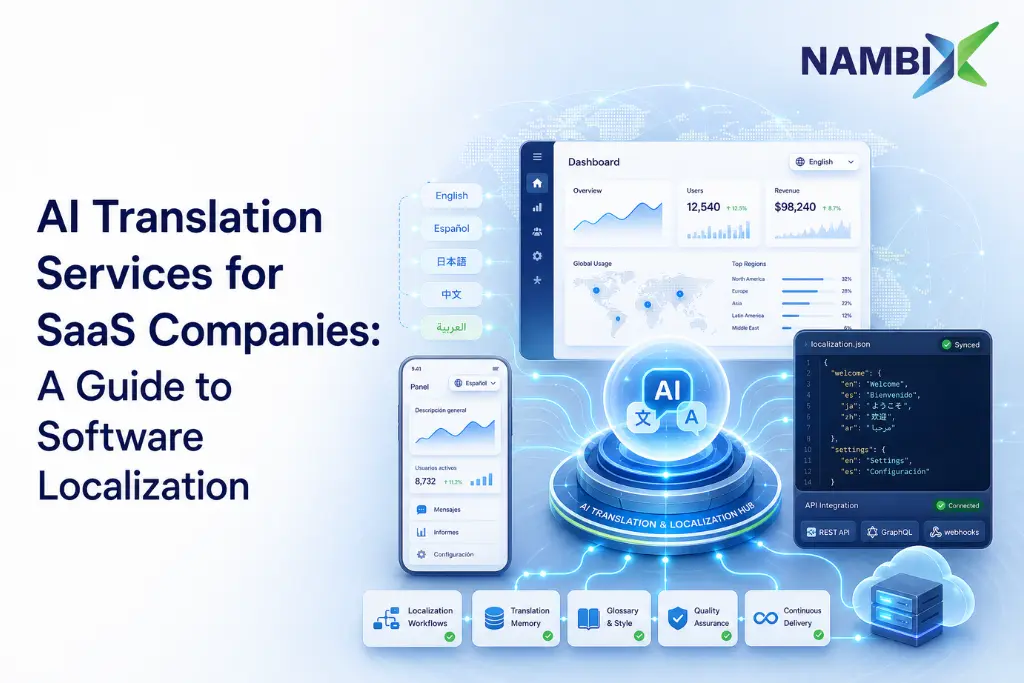
AI Translation Services for SaaS Companies: A Guide to Software Localization
AI translation services help SaaS companies adapt their software’s user interface, app strings, and support content into multiple languages faster than traditional human-only workflows, while a structured software localization process keeps translation quality, cultural context, and UI elements consistent across every target market. For SaaS teams entering new markets, combining ai translation with human oversight inside a repeatable localization workflow is now the fastest way to launch a product that feels native to users in their own language, release after release. This guide walks through how SaaS companies plan, build, and scale that process, and where Nambix’s AI translation services fit in.
What Are Software Localization Services, and Why Do SaaS Companies Need Them?
Software localization services go beyond swapping English text for another language. They adapt an application’s user interface, error messages, app store metadata, date and currency formats, and even color choices so a product feels like it was built for the target market, not translated into it. Software localization involves adapting software applications for target markets in a way that respects local norms, regulations, and expectations, and ongoing maintenance is necessary for software localization to stay current as features ship.
For SaaS companies specifically, the stakes are higher than a one-time website translation project. According to CSA Research, 76% of online shoppers prefer to buy products with information in their native language, and 40% say they will never buy from a site available only in another language. Companies should consider localization when entering diverse international markets, because localized software can increase international sales through better user engagement and can reduce customer support costs, since users run into fewer confusing screens and unclear error messages.
Because SaaS products ship updates constantly, localization can’t be a single project — it has to be a managed workflow that keeps pace with every release. That’s the core difference between website localization done once for a marketing site and the ongoing software localization services a growing SaaS product actually needs.
App Localization vs. Website Localization: What SaaS Teams Should Know
App localization and website localization overlap, but they aren’t the same job. App localization adapts functionality for different languages and cultures inside the product itself: onboarding flows, in-app notifications, settings menus, and the app’s user interface. Website localization, by contrast, covers the marketing site, documentation, and blog — content that supports the product rather than living inside it.
A SaaS company usually needs both, and they need to stay in sync. If your marketing site promises support for multiple languages but the web apps behind the signup button only render in English, users notice immediately. Maintaining consistency in brand voice and terminology across both surfaces is where a shared localization platform and a single glossary make the difference between a polished product and a disjointed one.
How to Prepare App Strings and Source Files for Accurate Translation
Successful localization usually begins with internationalization (i18n) — the engineering work that prepares apps for multiple languages and regions before a single word gets translated. Internationalization includes externalizing user-facing strings from code instead of hardcoding them, so translators work with clean resource files rather than digging through source files. Effective internationalization avoids code changes for new languages: once strings are externalized and locale-specific formats (dates, currencies, number separators) are handled generically, adding a new language becomes a translation task, not a development sprint.
Apps need internationalization to support locale-specific formats, and skipping this step is expensive later. Without internationalization, every new language requires code-level fixes, which slows down localization efforts and makes it harder to support multiple languages as the product grows.
Two details matter once strings are externalized. First, text expansion: German or Finnish translations can run 30–40% longer than English, so UI elements need room to grow, or buttons and labels break. Second, visual context: translators who can see how content appears on screen, not just an isolated string in a spreadsheet, produce far more accurate translation on the first pass than translators working blind.
The Software Localization Process: From Internationalization to Continuous Localization
A typical localization process runs through several stages: extracting UI strings from the codebase, building a glossary and translation memory, generating first pass translations, routing them through human oversight and linguistic quality assurance, testing in context, and deploying localized versions alongside the source release. Translation memory stores previously approved translations so the same UI strings and error messages aren’t retranslated (and re-billed) every release, and terminology management keeps product names, feature labels, and brand voice consistent across every language pair.
A dedicated app localization platform automates string data collection, which removes a huge amount of manual handoff between developers, product managers, and localization teams. Automating that collection step can reduce engineering time spent on localization by up to 30%, and automation across the broader localization workflow can reduce cycle times by over 50% compared with manual, spreadsheet-driven review workflows.
This is exactly why continuous localization supports faster multilingual releases: instead of batching translations into occasional big projects, new or changed strings flow into the localization workflow automatically as part of each sprint, so multilingual updates ship the same day as the English release rather than weeks later.
AI Translation and the Growing Role of App Translation for SaaS
Modern ai translation engines, built on large context window models, handle nuance, idioms, and product terminology far better than older statistical machine translation did. That makes them a strong starting point for first pass translations across many languages at once. But ai-assisted translation still benefits from human oversight, particularly for anything touching legal text, pricing, or brand voice, where translation errors carry real business risk.
Machine translation post-editing (MTPE) is the managed workflow most localization teams use to combine speed with translation quality: AI produces the first draft across every target language, and a linguist reviews it for cultural context and accuracy before it reaches the app store or
Nambix’s approach to AI-with-human editing treats human review as a quality layer you add where it matters most, rather than a bottleneck on every string — which is what lets SaaS teams support multiple languages without slowing down release cycles. For a deeper look at when full human translation is worth the extra time, see AI translation vs. human translation.
Effective App Localization Strategies to Reach a Global Audience
Effective app localization combines translation, design, and functionality adaptation — it’s not a translation task alone. Localization modifies user interfaces, graphics, and cultural formats together, so a screen that works well in English can be redesigned, not just retranslated, for a target language with a different reading direction or longer average word length.
Cultural adaptation involves modifying non-textual elements like images, icons, and colors, and localized software must meet local legal and cultural requirements around data handling, consent language, and payment methods. Practical steps for a SaaS team include:
- Localize UI elements, in-app messaging, and error messages, not just marketing copy
- Adapt currencies, measurement units, and date formats per target market
- Let users set their own language preference and switch it without contacting support
- Localize video content — onboarding walkthroughs and tutorials — alongside the interface
- Keep a shared glossary so localization teams maintain one brand voice across languages
Localization can enhance brand loyalty by showing respect for local cultures, and understanding local user expectations is crucial for effective software localization. For a market-specific example of adapting a product’s checkout and support experience, see AI translation for e-commerce localization.
App Store Optimization: Localization Efforts That Improve Downloads
App store optimization (ASO) improves app visibility and downloads, and it depends heavily on localization efforts. ASO involves optimizing app titles, keywords, and descriptions for each target market’s search behavior, not just translating the English listing word for word — search terms that drive downloads in the U.S. app store rarely match the terms people search for on Google Play in Brazil or Japan.
Localized app screenshots can increase download rates on their own, since most users decide whether to install an app based on the visuals before reading any description. Industry data backs this up: localized apps see roughly 128% more downloads per market than English-only versions, and revenue can climb around 26% within the first week of a localized launch. Despite that upside, a large share of apps — commonly cited around 70% — remain available in English only, which is a real opportunity for SaaS companies willing to invest in app store metadata translation for even a handful of additional languages.
Quality Assurance: Catching Localization Issues Before They Reach Users
Quality assurance testing is essential in the localization process to check functionality, not just wording. Localization mistakes can lead to user abandonment, and quality issues can damage an app’s reputation right at release, when first impressions matter most and reviews are hardest to walk back.
Pseudolocalization helps identify issues before translation begins, by wrapping source strings in accented or expanded placeholder text to reveal hardcoded strings, truncation, and layout problems early. Automated QA checks then catch formatting and layout issues pre-deploy, flagging untranslated strings, broken placeholders, and text overflow before a build reaches app store or Google Play review. Together, pseudolocalization and automated QA reduce the number of translation errors that make it into a live release.
When to Launch Localize: Timing Your Software Localization for New Markets
Not every SaaS company needs to support 20 languages on day one. Minimum viable localization focuses on key features and app store descriptions first — translating the core signup, onboarding, and billing flows plus the app store listing, then expanding coverage once a specific market shows real demand. This lets a team launch localize a product in one or two priority languages, validate demand and translation quality, and then add additional languages with a clear playbook rather than guessing.
Regulatory compliance is also a key aspect of software localization in markets with data residency, consumer protection, or accessibility rules, so it’s worth mapping legal requirements alongside language priority when picking new markets.
Comparing Localization Approaches for SaaS Companies
The right approach depends on how often you release, how many languages you need, and how much translation quality risk you can accept in a given screen. Here’s how the common options compare:
| Approach | Speed | Translation Quality | Fit for Continuous Localization | Best For |
| Raw machine translation only | Fastest | Inconsistent; error-prone for UI and legal text | Poor — no review layer to catch drift | Internal tools, low-risk content |
| Freelance translators, per project | Slow | High, but variable across translators | Weak — hard to scale with sprints | One-off campaigns |
| Traditional human-only LSP | Moderate | High and consistent | Moderate — often batch-based | Legal, regulated content |
| Nambix: AI translation + human oversight | Fast | High, with linguistic QA on priority content | Strong — built for ongoing release cycles | SaaS apps, e-commerce, product UI |
Why SaaS Companies Choose Nambix for Software Localization Services
Nambix Technologies builds AI translation, subtitling, captioning, and transcription services specifically for teams that need to support multiple languages without slowing down their release cadence. Nambix’s AI translation services pair large-context AI models with linguistic quality assurance, so app strings, UI elements, and app store metadata get accurate translation on the first pass, with human review layered in where it matters most, rather than required on every string.
For SaaS products that also ship product videos, help-center content, or webinars alongside the app, Nambix’s AI subtitling, AI captioning, and AI transcription services extend the same localization workflow to video content, so a product’s help videos and onboarding walkthroughs stay in sync with the localized UI. You can see how this comes together for real teams in Nambix’s case studies or learn more about Nambix and its approach to AI-forward, human-reviewed localization.
Ready to Localize Your SaaS Product?
Whether you’re preparing a first pass translation of your app’s UI or scaling to additional languages across a growing global audience, Nambix’s software localization services combine AI translation speed with human linguistic QA where it counts. Contact Nambix to scope your app strings, target markets, and timeline.
Frequently Asked Questions (FAQs)
What is the difference between software localization and translation?
Translation converts text from one language to another. Software localization is broader: it adapts the app’s user interface, formats, images, and functionality for a target market, translation included. Nambix’s software localization services handle both layers together, so translated content fits the product rather than sitting on top of it.
How long does it take to localize a SaaS app into multiple languages?
A minimum viable localization of core screens and app store metadata into one language can take one to two weeks with an AI-assisted workflow; adding many languages in parallel typically adds a few days per language pair for linguistic QA rather than restarting the process. Nambix’s continuous localization workflow is built to keep pace with regular SaaS release cycles rather than treating each language as a separate project.
What file formats do localization platforms support for app strings?
Most localization platforms handle common resource file formats such as JSON, XML, .strings, .po/.pot, and YAML, alongside spreadsheet exports for review. Nambix works with SaaS teams’ existing file formats and source files, so developers don’t need to restructure their codebase to start localizing.
Do I need human translators if I use AI translation?
For most UI strings, AI translation with automated QA is sufficient. For legal text, pricing, marketing copy, and anything tied closely to brand voice, human oversight materially reduces translation errors and protects translation quality. Nambix’s MTPE-based workflow applies human review selectively, to the content where it has the most impact.
How much does app localization cost for a SaaS product?
Cost depends on word volume, number of target languages, and how much human review each string needs — AI-assisted first pass translations lower the baseline cost significantly compared with fully human translation. Nambix scopes pricing per project after reviewing your app strings and target markets, so teams only pay for the level of human oversight each piece of content actually needs.
Which languages should I localize my SaaS app into first?
Start with the languages tied to your largest addressable markets or existing user demand — sign-up geography, support ticket language, and competitor presence are good signals. Nambix can help prioritize target markets based on where your own preferences and usage data point, rather than localizing every language at once.
How does continuous localization fit into an agile release cycle?
Continuous localization connects your localization platform directly to your development pipeline, so new or changed strings are sent for translation automatically as part of each sprint instead of being batched for a separate localization phase. Nambix’s managed workflow plugs into this cycle so multilingual releases ship alongside your English release, not weeks behind it.
