
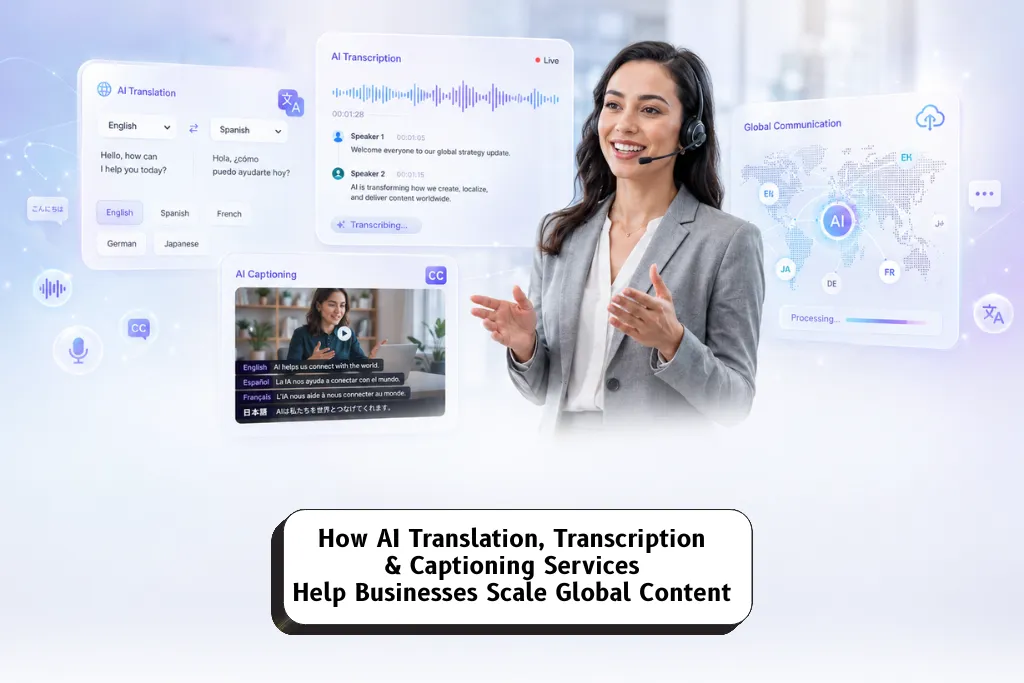
Businesses that want to reach international markets need a fast, reliable way to turn one piece of content into many languages without slowing down production. AI translation services, AI-powered transcription, and auto captions now make this possible at a scale that manual processes simply cannot match. By combining machine translation engines, large language models, and automated workflow tools, companies can translate text, video content, and documents into multiple languages in minutes rather than weeks, then route anything that needs a closer look through human oversight. This is exactly the kind of AI-powered localization platform that Nambix Technologies has built its services around — helping teams scale multilingual content across websites, video, and documents with speed, consistency, and enterprise-grade security.
Why AI Translation Services Are Reshaping Global Content Strategy
Global content used to mean long timelines, multiple vendors, and unpredictable costs. AI translation has changed that equation. Modern AI translation services can process thousands of words in seconds, which means a document that once took days to translate can now produce a usable first draft almost instantly. This speed doesn’t come at the expense of relevance — AI translation systems generate translations that sound more natural than word-for-word translations, because they’re built to understand sentence-level meaning rather than swapping words one at a time.
This shift matters most for businesses trying to reach a global audience across dozens of language pairs at once. Instead of scheduling translation tasks sequentially, teams can run parallel jobs across a translation management system, tracking every language pair from a single dashboard. AI translation services support over 100 languages for global communication, giving businesses access to markets that were previously too costly or too slow to serve with traditional methods. AI translation supports a broader range of languages than traditional methods, including many regional and lower-resource languages that human-only pipelines often skip due to cost.
Nambix Technologies applies this same logic across its AI translation services — helping businesses treat localization as a continuous process rather than a one-off project, so international markets can be entered on a realistic timeline instead of a multi-month one.
Machine Translation and Neural Machine Translation: What’s Actually Different Now
“Machine translation” today looks very different from the rule-based systems of a decade ago. Neural machine translation uses machine learning models trained on massive multilingual datasets, which allows the system to weigh context, tone, and sentence structure rather than translating in isolated chunks. Modern AI systems are trained on large multilingual datasets to understand context, which is why translation quality has improved so significantly in recent years — a well-tuned machine translation engine can pick up on idioms, formality levels, and industry terminology in ways older systems couldn’t.
Large language models have added another layer of capability. Because these models are trained on enormous amounts of text across many domains, they can generate translations that adapt to context rather than defaulting to a literal rendering. This is especially useful for domain-specific terminology — legal, medical, or technical content where a generic translation tool would miss the intended meaning. AI translation’s effectiveness can vary greatly depending on language and context, which is why matching the right machine translation engine to the right content type matters as much as the technology itself.
Nambix Technologies builds its translation workflows around this reality, selecting and tuning machine translation engines by language pair and content type so that the output is genuinely usable rather than a rough approximation.
Translation Quality: How AI-Powered Systems Get It Right
Translation quality is where AI translation services have made the biggest leap. Context aware translations are now standard rather than exceptional — systems evaluate surrounding sentences, prior terminology choices, and even formatting cues to produce accurate translations that read naturally in the target language. AI translation can preserve formatting and translate text from images using OCR, which means a scanned PDF, a slide deck, or a screenshot with embedded text can go through the same translation tool as a plain text document, with the original layout intact.
Quality assurance has also become more automated. AI-powered QA checks can flag inconsistent terminology, mistranslated numbers, or formatting mismatches before a project manager ever opens the file, cutting down on time-consuming tasks that used to require a full manual review pass. AI translation services enhance speed, quality, and cost-effectiveness together, rather than forcing a tradeoff between them — a business no longer has to choose between a fast turnaround and an accurate one.
For high-stakes documents — contracts, regulatory filings, or public-facing brand content — human review is recommended for high-stakes documents to ensure accuracy and nuance is preserved alongside speed. Nambix Technologies structures its translation services so that this kind of oversight is available as part of the workflow, not a separate bottleneck, so translation quality stays high without adding weeks to the timeline.
Human Expertise Working Alongside AI Translation
None of this means AI works in isolation. AI translation services combine machine translation with human oversight to strengthen results, using human expertise where nuance, brand voice, or cultural context matters most. Instead of replacing translation services with automation, this pairing lets AI handle high-volume, repeatable translation tasks — first drafts, glossary creation, formatting — while human reviewers focus their time on the parts of a project where judgment adds the most value.
This is a meaningful shift in how localization workflows are structured. Rather than routing every single word through a person, teams can define workflow controls that automatically send flagged segments — new terminology, idiomatic phrases, tone-sensitive sections — for review, while routine content moves straight through. The result is human expertise applied precisely where it counts, without slowing down the volume of multilingual content a business needs to produce.
Nambix Technologies designs its translation services around this same principle: AI tools drive the throughput, and human expertise is layered in as a quality lever wherever a project calls for it, keeping brand voice and terminology management consistent across every language.
Auto Captions and AI Tools for Video Content
Video content is one of the fastest-growing formats for global communication, and AI tools have made subtitle creation and auto captions dramatically faster to produce. Where captioning a video once meant manually timing every line of dialogue, AI transcription now generates a first draft of translated subtitles automatically, matched to the original audio’s timing. From there, a project manager can adjust word choice, add context, or fine-tune timing without starting from scratch.
Auto captions also make video content accessible to a global audience who may be watching without sound or who speak a different language than the original recording. Because captions and translated audio can be generated from the same source file, a single video can be repurposed into a dozen language versions without re-recording anything. This allows businesses to localize content faster, reduce production costs, and deliver a more natural viewing experience for international audiences.
Nambix Technologies applies this same AI-powered approach to video localization — generating accurate captions and translated subtitles quickly, so businesses can publish video content across markets without a separate production cycle for every language.
AI Tools for File Formats, Terminology Management, and Workflow Automation
Scaling multilingual content isn’t only about translating text — it’s about handling every file format a business actually works with. A capable translation tool needs to accept documents, spreadsheets, presentations, images, and video without forcing a team to convert files manually first. Document translation that preserves the original document’s layout, fonts, and structure saves significant time compared to rebuilding a translated file from scratch.
Terminology management is another area where AI tools have automated what used to be a manual, time-consuming task. AI tools can automate glossary creation for translation projects, scanning existing content to identify key terms and build out a style guide automatically. AI can assist in extracting domain-specific terminology from documents, which helps maintain consistent terminology across every translation task in a project — even when multiple translators or reviewers are working on the same account. Effective terminology management reduces preparation time for translators, and terminology management helps maintain consistent language across projects as content volume grows.
Workflow automation ties all of this together. Instead of manually assigning each translation task, a translation management system can automatically route files by language pair, content type, or urgency, freeing up project managers to focus on oversight rather than file handling. AI-driven workflows can reduce translation preparation time by automating glossary creation, terminology extraction, and initial quality checks before a task ever reaches a human reviewer.
Nambix Technologies brings these capabilities together in a single localization platform — supporting a wide range of file formats, automating terminology management, and giving project managers real-time visibility into every translation task, so localization processes stay organized even as multilingual content scales across dozens of languages.
Getting Started: A Simple, User-Friendly Workflow
Adopting AI translation services doesn’t need to be complicated. Most teams start with a simple, step-by-step process:
Upload the original document, video, or audio file — Nambix Technologies’ translation tool accepts a wide range of file formats without requiring manual conversion.
Select the target language or languages, choosing from a list that spans over 100 languages for global communication.
Add context, such as a style guide, existing glossary, or brand voice notes, so the AI-powered engine can tailor output to the intended audience.
Generate the first draft through the machine translation engine, complete with visual elements and formatting preserved from the original document.
Run QA checks to catch terminology or consistency issues automatically before the file moves forward.
Route for human review where needed — high-stakes or brand-sensitive content can be flagged for closer attention without holding up the rest of the project.
This user-friendly setup means a new project can go from upload to a usable translated file in the same day, whether the output is a translated document, accurate captions for a video, or translated audio for a global campaign. Nambix Technologies offers a free plan for teams that want to test this workflow on a smaller project before scaling it across an entire content library.
Frequently Asked Questions (FAQs)
1. How accurate is AI translation compared to human translation?
Accuracy depends heavily on the language pair, content type, and how well the AI system has been trained on relevant context — general content tends to translate very accurately, while highly technical or idiomatic text benefits from a closer look. Nambix Technologies combines advanced machine translation engines with optional human review, so businesses get accurate translations quickly while still having the option to add human expertise for sensitive or high-stakes content.
2. Can AI translation handle documents with images, tables, or complex formatting?
Yes — modern AI translation tools can extract text from images using OCR and translate it while preserving the original document’s layout, tables, and formatting. Nambix Technologies’ translation tool is built to handle document translation across multiple file formats without requiring teams to manually rebuild files after translation.
3. What languages do AI translation services support?
Leading AI translation platforms now support well over 100 languages, including many regional languages that traditional translation services often overlook due to cost or demand. Nambix Technologies supports a broad range of languages and language pairs, making it practical for businesses to enter new international markets without waiting on limited language availability.
4. How does AI improve terminology management for large projects?
AI tools can automatically extract domain-specific terminology from existing content and build a glossary, which keeps language consistent even as multiple people work on the same project. Nambix Technologies uses this kind of automated terminology management to maintain consistent terminology and brand voice across every translation task in a project, reducing manual cleanup later.
5. Can AI generate captions and subtitles for video content automatically?
Yes — AI transcription can generate accurate captions and translated subtitles directly from a video’s audio track, matching the original timing automatically. Nambix Technologies’ captioning tools produce auto captions and translated subtitles quickly, helping teams publish video content across multiple languages without a separate production step for each one.
6. Is AI translation secure enough for sensitive business documents?
Reputable AI translation platforms are built with enterprise-grade security standards, including encrypted file handling and controlled access to uploaded content. Nambix Technologies applies these same security practices across its translation services, so businesses can translate confidential documents without added risk.
7. Do I need technical skills to use an AI translation platform?
No — most AI translation tools are designed to be user-friendly, with a simple upload-select-translate flow that doesn’t require any technical background. Nambix Technologies’ platform follows straightforward, step-by-step instructions so any team member can start a new project, from uploading a file to downloading the translated output, without specialized training.
