
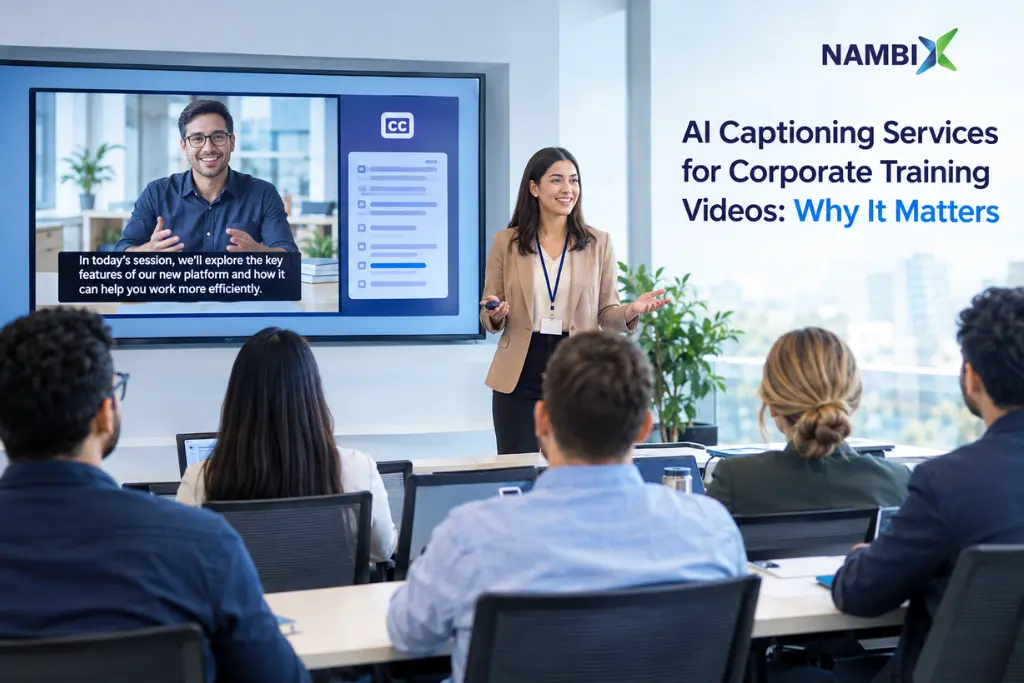
AI Captioning Services for Corporate Training Videos: Why It Matters
AI captioning services for corporate training videos use automatic speech recognition (ASR) to convert spoken narration into accurate, time-synced on-screen text, so every learner can follow the content regardless of hearing ability, native language, accent familiarity, or the noise level of their environment. For L&D, HR, and compliance teams running video-first onboarding, safety, and skills programs, captioning has shifted from an accessibility afterthought to a core requirement for comprehension, legal risk management, and measurable training ROI.
The Shift to Video-First Corporate Training
Corporate training has moved decisively toward video. As of 2026, an estimated 93% to 98% of organizations use video as a primary format for employee training, and video-based onboarding drives 82% higher new-hire retention than text-first programs. The reason is simple: learners retain roughly 95% of information delivered through video, compared to just 10% when the same material is delivered as plain text.
This shift is accelerated by distributed teams. Roughly 73% of companies now operate hybrid or fully remote workforces, and video has become the default way to deliver consistent training across locations and time zones. Yet 63% of remote employees report feeling undertrained during onboarding — a gap that well-structured, accessible video content is uniquely positioned to close. The catch is that a training video only delivers on these gains if every viewer can actually understand it, and that is exactly where captioning becomes non-negotiable rather than optional.
Why Captions Matter More Than Ever for Training Content
Corporate training videos are watched in far less controlled conditions than a marketing video or a movie. Employees watch onboarding modules on a warehouse floor, between calls in an open-plan office, on a phone with the sound off, or in a language that isn’t their first. Captions solve for all of these situations at once, which is why the underlying data on captioned video is so consistent:
- Captioned videos see up to a 40% increase in viewer retention compared to uncaptioned videos (National Center for Accessible Media).
- Videos with captions achieve up to 40% higher completion rates than the same content without captions.
- According to UK regulator Ofcom, 80% of people who turn captions on are not hearing impaired — most are using them for comprehension in noisy or sound-off environments, which describes the average workplace.
- Globally, more than 1.5 billion people live with some degree of hearing loss, including 430 million with disabling hearing loss, according to the World Health Organization’s 2025 fact sheet on deafness and hearing loss — a population no large employer’s training program can afford to overlook.
For the underlying figures, see the WHO Deafness and Hearing Loss fact sheet, which the statistics above are drawn from.
Business Impact of Captioned Training Videos
| Metric | Impact of Captions | Source |
| Viewer / learner retention | Up to 40% increase vs. uncaptioned video | NCAM |
| Video completion rate | Up to 40% higher completion | Video engagement research, 2026 |
| Caption usage growth | Up 572% since 2021 across platforms | Wistia State of Video |
| Information retention (video vs. text) | 95% retained from video vs. 10% from text | Research.com, 2026 |
| AI caption accuracy (clear audio) | 90% to 98% on common languages | Industry ASR benchmarks, 2026 |
| People affected by hearing loss globally | 1.5 billion+, incl. 430 million disabling | WHO Fact Sheet, 2025 |
Legal and Compliance Risk: ADA, WCAG, and Section 508
Accessibility litigation is not slowing down, and it is no longer only an e-commerce problem. Plaintiffs filed 3,117 federal website and digital-accessibility lawsuits in the U.S. in 2025 — a 27% increase over 2024 — and total federal-plus-state digital accessibility filings topped 5,000 for the year, according to Seyfarth Shaw’s ADA Title III tracking. Roughly two-thirds of 2024 lawsuits targeted companies with under $25 million in annual revenue, which means training portals, internal LMS platforms, and employee-facing video libraries at mid-sized organizations carry real exposure, not just Fortune 500 public websites.
The compliance bar itself is well established. Web Content Accessibility Guidelines (WCAG) 2.1/2.2 Level AA — the standard most courts and settlement agreements reference — requires captions for prerecorded audio content under Success Criterion 1.2.2. Section 508 imposes an equivalent requirement on U.S. federal agencies and their contractors. If a corporate training video lives on an intranet, LMS, or internal portal, it typically falls within the spirit — and often the letter — of these same standards, especially for organizations that are federal contractors, publicly traded, or operating in regulated industries such as healthcare, BFSI, or education.
Captioning every training video by default is one of the most cost-effective ways to close this gap before it becomes a legal or HR issue, while simultaneously making the content usable for a wider range of employees.
Global, Multilingual Workforces Need More Than English Captions
Multinational employers, manufacturers with distributed plant workforces, and BPOs with multi-country delivery centers face a second challenge that English-only captions don’t solve: language. A single training video captioned only in English still excludes non-native speakers, frontline and deskless staff, and employees in regional offices who learn faster in their own language.
AI-generated multilingual captions and subtitles let one master training video serve every market and every language a workforce speaks, without re-shooting or re-recording anything. This is especially valuable for safety training, compliance modules, and product training that must be delivered identically across geographies — consistency that plain translation of a PDF or slide deck cannot guarantee in the way a captioned or subtitled video can.
AI Captioning vs. Manual Captioning for Training Content
Most L&D teams choosing a captioning approach are really choosing between speed and scale versus a fully manual, human-only process. In practice, the two are not mutually exclusive — AI captioning with optional human post-editing (MTPE) is increasingly the standard for content where absolute precision matters, such as compliance or safety training.
AI Captioning vs. Manual (Human) Captioning
| Factor | AI Captioning | Manual / Human-Only Captioning |
| Turnaround time | Minutes to hours, even for long libraries | Days to weeks per batch |
| Cost at scale | Low per-minute cost; scales across hundreds of videos | High per-minute cost; scales linearly with headcount |
| Accuracy on clear audio | 90% to 98%, improvable with MTPE review | Very high, dependent on individual transcriber |
| Multilingual reach | Dozens of languages from a single workflow | Limited by available linguist availability |
| Best fit | Large libraries, frequent updates, multilingual rollouts | Low-volume, highly technical, or legally sensitive one-offs |
How AI Captioning Fits Into the L&D Content Workflow
For captions to be useful, they need to move cleanly from the captioning tool into whatever plays the video — an LMS, a video hosting platform, or a company intranet. Nambix’s AI Captioning Services and its vSubtitle product generate captions in standard formats — including SRT, VTT, and TTML — so files drop directly into common LMS platforms and video players without reformatting, and timing stays frame-accurate as videos are trimmed, re-versioned, or repurposed across modules.
This matters operationally: L&D teams that regularly refresh onboarding, compliance, and product-training libraries need a captioning workflow that keeps pace with content updates rather than becoming a bottleneck every time a video changes.
MTPE: When Human Review Still Adds Value
For high-stakes training content — regulatory compliance, safety procedures, harassment-prevention training, or anything with legal or audit implications — many organizations add a light human review layer on top of AI captions. This is Machine Translation Post-Editing (MTPE), and Nambix positions it as an optional quality layer on top of automation, not a required correction step. AI captioning speed and scale remain the default; a human reviewer is added selectively, for the specific modules where terminology precision, brand voice, or legal accuracy justify it. More detail on this hybrid model is available on Nambix’s page for AI with human editing (MTPE) services.
Best Practices for Implementing AI Captioning in Corporate Training Programs
- Audit the existing training video library first, prioritizing safety, compliance, and onboarding content where accessibility gaps carry the most legal and operational risk.
- Caption every new training video by default rather than reactively, so accessibility and comprehension are built into content from the start rather than retrofitted.
- Use AI captioning for speed and volume, and reserve human review (MTPE) for content where terminology, regulatory language, or brand voice must be exact.
- Add multilingual captions or subtitles wherever a workforce spans multiple regions or includes non-native speakers of the primary training language.
- Export in LMS-compatible formats (SRT, VTT, TTML) so captions integrate with existing learning platforms without manual reformatting.
- Track completion and assessment-score data before and after captioning is added, to quantify the retention and completion gains for stakeholders.
Nambix’s Approach to AI Captioning for Corporate Training
Nambix Technologies is built around the idea that AI can fully handle high-volume, time-sensitive language workflows, with human expertise available as an optional add-on rather than a mandatory checkpoint. For corporate training video libraries — which are often large, frequently updated, and increasingly multilingual — that approach maps directly onto what L&D teams need: fast, accurate captions that keep content accessible, compliant, and consistent as the library grows. Nambix’s AI Captioning Services cover exactly this use case, alongside related AI Transcription and AI Subtitling services, and Nambix works across the industries — from BFSI and healthcare to e-commerce and education — where video-based training and compliance content is most exposed to accessibility risk.
Ready to make every corporate training video accessible, compliant, and multilingual? Explore Nambix’s AI Captioning Services or get in touch to caption your training library at scale.
Frequently Asked Questions (FAQs)
1. What are AI captioning services for corporate training videos?
They use automatic speech recognition to generate accurate, time-synced text captions for training videos automatically, without a human transcribing the audio from scratch. Nambix’s AI captioning services apply this specifically to L&D content, delivering caption files ready for any LMS or video platform.
2. How accurate is AI captioning compared to human captioning?
Modern AI captioning typically reaches 90% to 98% accuracy on clear audio in common languages, which is close to professional human transcription for most training content. Nambix offers an optional MTPE review layer to push accuracy even higher on compliance-critical modules.
3. Are captions legally required for corporate training videos?
Requirements depend on jurisdiction, industry, and whether an organization is a federal contractor, but WCAG 2.1/2.2 Level AA (Success Criterion 1.2.2) and Section 508 both call for captions on prerecorded audio content, and digital accessibility lawsuits have risen sharply in recent years. Nambix helps organizations caption training libraries proactively to reduce this exposure.
4. What’s the difference between captions and subtitles?
Captions transcribe spoken dialogue and relevant audio cues in the same language as the video, primarily for accessibility and comprehension; subtitles translate that dialogue into another language for viewers who don’t speak the original audio language. Nambix offers both as separate services — AI Captioning and AI Subtitling — since training programs often need each for different audiences.
5. Can AI captioning support multiple languages for global teams?
Yes — AI-generated captions and subtitles can be produced in dozens of languages from a single source video, letting one training asset serve every regional team consistently. Nambix combines AI captioning with its AI translation and subtitling services to support exactly this kind of multilingual rollout.
6. Do AI captions work with LMS platforms like Cornerstone, Docebo, or SAP SuccessFactors?
Captions delivered in standard formats such as SRT, VTT, and TTML are compatible with virtually every major LMS and video hosting platform, since these are industry-standard caption file types rather than proprietary formats. Nambix delivers captions in these formats by default so files integrate directly into an existing LMS workflow.
7. How long does it take to caption a training video with AI?
AI captioning typically turns around a single video in minutes to a few hours, even for large libraries, compared to days or weeks for fully manual captioning. Nambix’s AI-powered workflow is built to caption high volumes of training content quickly without sacrificing accuracy.
8. What file formats do AI captioning services deliver?
Common deliverables include SRT, VTT, and TTML caption files, along with burned-in (open) captions where a hardcoded caption track is preferred. Nambix’s vSubtitle product supports these export formats so captions plug into whatever platform hosts the training content.
9. Should we use MTPE for compliance-critical training videos?
For content with legal, regulatory, or safety implications, adding a human review pass (Machine Translation Post-Editing) on top of AI-generated captions is a sensible extra safeguard for terminology and accuracy. Nambix offers MTPE as an optional add-on specifically for these higher-stakes modules, while keeping AI-first speed for the rest of the library.
10. Do captions actually improve knowledge retention in training?
Yes — captioned videos see up to a 40% increase in viewer retention and up to 40% higher completion rates compared to uncaptioned videos, and video overall drives roughly 95% information retention versus 10% for text alone. Nambix’s AI captioning is designed to help L&D teams capture these retention gains across an entire training library, not just a handful of flagship videos.
11. How much does AI captioning cost compared to traditional captioning?
AI captioning is generally priced per minute of video and costs a fraction of fully manual, human-only captioning, especially at the scale of a full corporate training library. Nambix’s pricing reflects this AI-first efficiency, with optional MTPE priced separately for videos that need an added human review layer.
Key Takeaways
- Video now drives the majority of corporate training, but its retention and completion benefits only hold if every learner can understand the content — which is where captions come in.
- Captioned training videos see up to 40% higher retention and completion rates than uncaptioned videos, while video overall delivers roughly 95% information retention versus 10% for text.
- Digital accessibility litigation rose 27% in 2025 and increasingly targets mid-sized organizations, not just large e-commerce brands, making proactive captioning a real risk-mitigation step.
- WCAG 2.1/2.2 Level AA and Section 508 both require captions on prerecorded audio/video content, a bar that internal LMS and intranet training videos should meet as much as public-facing content.
- AI captioning delivers 90% to 98% accuracy on clear audio at a fraction of the cost and turnaround time of manual captioning, with optional MTPE review for compliance-critical modules.
- Multilingual AI captions and subtitles let a single training video serve global, multilingual workforces consistently, without re-recording content per region.
- Nambix’s AI Captioning Services and vSubtitle product deliver LMS-ready caption files (SRT, VTT, TTML) so accessibility and compliance are built into training content from day one.
Related Blogs and Articles
- AI Captioning for ADA & WCAG Compliance
- ADA & WCAG Compliance: Digital Accessibility Through AI Captioning
- Video Captioning Services for eLearning Courses
- Why Businesses Need Professional AI Captioning
- Automated Subtitling for Video Content
- How Smart Transcription Tools Help Make Online Learning More Engaging
