
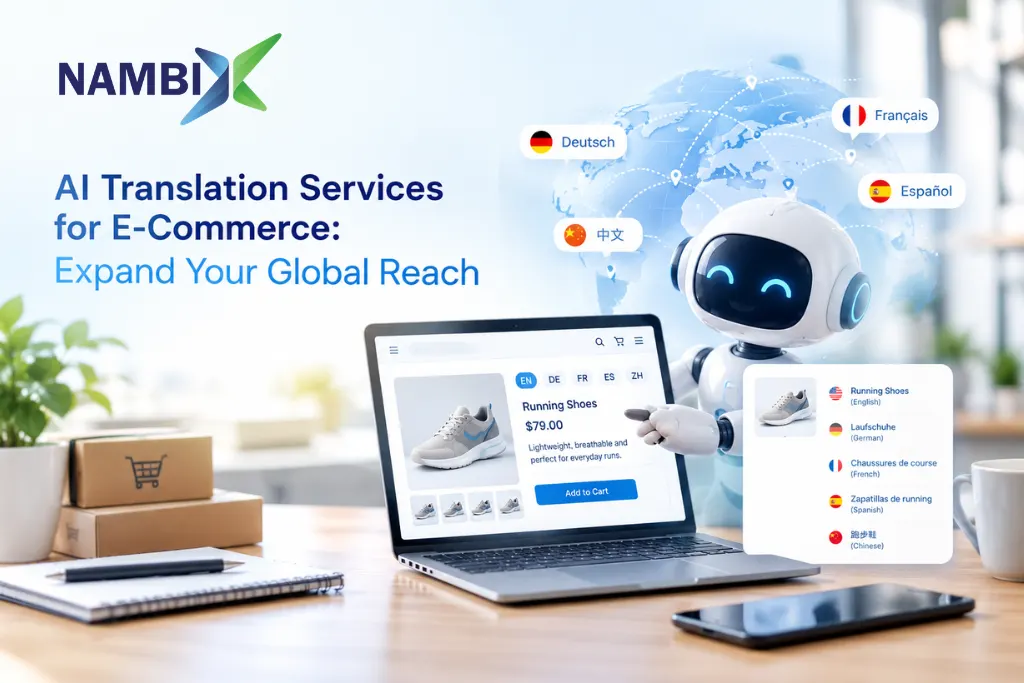
AI Translation Services for E-Commerce: Expand Your Global Reach
AI translation services for ecommerce use neural machine translation and large language models to convert product descriptions, storefronts, and marketing content into a target language in minutes rather than weeks, so online sellers can enter new markets without waiting on a traditional translation process. For e-commerce companies weighing growth against budget, AI translation tools now deliver high quality translations at most of the speed and cost advantage of automation while still allowing human review where brand consistency and cultural nuances matter. Nambix Technologies builds exactly this kind of AI-powered translation workflow for online retailers expanding across borders.
Why Language Is the Real Barrier to International Expansion
Cross-border e-commerce is one of the fastest-growing parts of global retail, with Capital One Shopping Research estimating the market at roughly $1.31 trillion in 2026 and projecting growth to about $1.84 trillion by 2030. Yet most of that growth bypasses merchants who sell in one language only, because shopping is a trust decision before it is a transaction.
CSA Research’s long-running “Can’t Read, Won’t Buy” study, based on a survey of 8,709 consumers across 29 countries, found that 76% of online shoppers prefer to buy products with information in their native language, and 40% will never buy from a website in another language. Other industry surveys place the figure closer to 70% to 75% of consumers, but the direction is consistent: customers shop in their own language first and everyone else’s second.
The commercial case is just as direct. CSA Research’s analysis of Fortune 500 companies found that firms which increased their translation budget were 1.5 times more likely to report an increase in total revenue than peers that did not, and companies prioritizing translation showed similar gains in profit and market share. For e-commerce companies, closing the language barrier is not a localization nicety, it is a straightforward growth lever.
What Are AI Translation Services for E Commerce?
AI translation services for ecommerce apply automated translation technology to the specific content types an online store produces: product descriptions, category pages, checkout flows, marketing content, and customer support messages. Instead of a translator rewriting every sentence from scratch, neural machine translation reads the source text and predicts the most natural translation in the target language, using neural networks trained on billions of sentence pairs.
Modern systems go further than older machine translation did. Large language models and neural MT engines analyze entire sentences for context rather than translating word by word, which improves accuracy on idioms, product jargon, and brand terminology. Many platforms also integrate seamlessly with existing workflows, so a product catalog can be translated directly from a CMS, spreadsheet, or e commerce platform without manual copy-paste, instead of forcing a team to paste text field by field.
How AI Translation Works: From Source Text to Storefront
The translation process behind most AI translation tools follows a consistent pattern:
- Source text extraction: product titles, descriptions, and marketing copy are pulled from the original document or platform, keeping the original text intact for reference.
- Machine translation: a neural machine translation engine is used to translate text into one or more target languages, using translation memory to reuse previously approved phrases and remove language barriers before a human ever sees the page.
- Quality assurance: automated checks flag untranslated strings, broken placeholders, and inconsistent terminology.
- Human review: for customer-facing content, a human editor checks tone, cultural context, and brand consistency before publishing.
- Publishing: translated content is pushed back into the website or app, often through direct integrations rather than manual file transfer.
Because this pipeline is automated end to end, AI translation can process thousands of product listings far faster than a traditional, fully human translation process, which is why e commerce companies use it to translate entire catalogs ahead of a market launch rather than one page at a time, with human translators brought in only where it counts most.
Free Consumer Translation Tools, AI Translation Tools, and Human Translation: What’s the Difference?
Not all machine translation is built for commerce. Free, consumer-grade translation tools are useful to paste text and get the gist, but they are not built for brand consistency, glossary management, or workflow integrations, and using them directly on a storefront can produce inconsistent terminology across pages. Purpose-built, user friendly AI translation tools add the business layer that ecommerce needs, with AI powered translation doing the heavy lifting on volume.
| Factor | Free Consumer Translation Tools | Business AI Translation Services |
| Terminology control | No glossary or brand terms | Supports glossaries for consistent terminology |
| Translation memory | None | Reuses approved translations across pages |
| File formats | Plain text only | Handles product feeds, CMS exports, multiple file formats |
| Human review option | Not available | Optional human editing / MTPE layer |
| Integrations | Manual copy-paste | Integrates seamlessly with existing workflows and platforms |
| Best for | Quick, one-off lookups | Product catalogs, storefronts, ongoing localization |
Professional translators and human translation still have a role, particularly for flagship marketing campaigns, legal pages, and any content where cultural nuances carry real brand risk. Nambix frames this as a spectrum rather than a binary choice: AI handles volume and speed, and Machine Translation Post-Editing (MTPE) adds human review wherever it earns its cost.
Product Descriptions, Brand Consistency, and Professional Translators
Product descriptions carry the most translation volume on any storefront, and they are also where brand consistency is easiest to lose: one page calling a feature a “setting” and the next calling it a “preference” confuses shoppers in any language. A shared glossary keeps terminology aligned across thousands of product descriptions, while professional translators review the handful of pages, the homepage, top category pages, flagship campaigns, where tone matters as much as accuracy.
How AI Translation Tools Reduce Costs for Ecommerce Companies
Cost is usually the deciding factor in whether a smaller e-commerce company attempts international expansion into a new international market. Industry data consistently points to significant savings from AI-assisted translation, making it a cost effective way to test demand before committing to a full localization budget:
- Smartling’s State of Translation research found that AI-assisted tools can reduce per-word translation costs by up to 40% compared to fully manual translation.
- A hybrid workflow, AI translation with human post-editing, typically runs 40% to 60% lower in total cost than translation done entirely by professional translators.
- Translation memory reuse is a major contributor: once 30% to 60% of a product catalog’s content has been translated and approved, that same memory, product specs, recurring descriptions, and boilerplate, can be reused automatically on new listings, which compounds savings in year two and beyond.
- Automated, AI-first translation workflows can cut total localization costs by as much as 70% compared to a fully manual process, according to vendor and industry cost analyses.
For a small business testing a new market, this cost structure is the difference between a cautious pilot and a full catalog launch, and it works across different languages without a separate vendor contract for each one. Nambix’s AI Translation Services are built around this same logic: pay for AI-powered speed on the bulk of the catalog, and reserve paid human review for the pages that carry the most commercial weight.
Beyond Translation: Why Ecommerce Needs Website Localization
Translating text is only part of making a store feel native to a shopper, wherever in the world that shopper is. Website localization adapts the full experience, currency formats, measurement units, date formats, payment methods, and even layout direction for right-to-left languages, to match local expectations. User experience localization adapts website layouts so navigation, filters, and checkout flows feel familiar rather than foreign.
The payoff shows up in behavior, not just sentiment. Localized product pages that use the right keywords in the target language can rank better in search engines in that market, since search engines match queries to the language and terms shoppers actually type. Culturally relevant shopping experiences, from imagery to seasonal promotions, are also linked to higher conversion rates in regional studies, because the store feels designed for that customer rather than translated for them as an afterthought, maintaining consistency between what a shopper expects and what the website actually shows.
Real-time translation inside customer support, through chat and help-desk tools, extends this further: when a shopper can get support in the languages they actually speak at the moment of hesitation, engagement and resolution both improve on websites around the world, which supports the post-purchase loyalty that repeat international revenue depends on.
Choosing New Markets and New Languages: Where to Localize First
Most e-commerce companies cannot localize into every language at once, so sequencing matters. A simple way to prioritize new languages is to combine market size with existing demand signals.
| Signal | What to Check | Why It Matters |
| Existing traffic | Visitors already arriving from a country in your analytics | Shows organic demand before you invest |
| Language pairs | Which source and target languages your catalog already supports | Determines translation memory reuse |
| Market size | Cross-border ecommerce growth and category demand in the country | Sizes the opportunity |
| Competitive gap | Whether competitors already sell in that language | Flags underserved markets |
| Support capacity | Whether you can resource customer support in that language | Avoids launching without follow-through |
French and German remain two of the highest-volume languages for European e-commerce expansion, while Spanish and Portuguese open large Latin American markets; Nambix’s AI Translation Services for Global Businesses and AI Translation Services for SaaS Companies cover the broader language-pair planning that applies across industries.
Continuous Localization: Keeping New Languages in Sync with Your Catalog
A one-time translation project goes stale the moment you add new products or update pricing. Continuous localization treats translation as an ongoing workflow rather than a project: new or changed product descriptions are detected automatically, translated through the same AI translation tools and translation memory, and reviewed only where human editing is warranted, before publishing back to the storefront. This keeps every language version current without requiring a full re-translation cycle every time the catalog changes, which is particularly valuable for e-commerce companies that add new SKUs weekly.
AI Agents and the Next Wave of Ecommerce Localization
The next step beyond batch translation is AI agents that handle more of the localization process end to end, monitoring a product feed, translating new entries, checking brand terminology against a glossary, and flagging only the exceptions for human review. This does not replace professional translators on high-stakes content, but it narrows their workload to the pages that genuinely need a human judgment call, which is where AI innovations are heading across the localization industry in 2026 and beyond.
How Nambix Supports Ecommerce Localization
Nambix Technologies positions AI as fully capable of handling high-volume ecommerce translation on its own, with human review offered as an optional quality layer rather than a mandatory step. In practice, that means a product catalog can move through Nambix’s AI translation pipeline at full speed by default, with MTPE added selectively for flagship marketing pages, legal and compliance content, or any copy where cultural context and brand voice are especially sensitive. This sits alongside Nambix’s wider AI Transcription, AI Captioning, and AI Subtitling services, so a single partner can localize product copy, support content, and video assets together. Nambix works with e-commerce businesses alongside other industries. To scope a catalog translation workflow, get in touch with Nambix.
Frequently Asked Questions (FAQs)
1. What are AI translation services for ecommerce?
AI translation services for ecommerce use neural machine translation and large language models to translate product descriptions, storefronts, and marketing content into other languages quickly and at lower cost than fully manual translation. Nambix’s AI Translation Services apply this directly to online catalogs and customer-facing pages.
2. How much do consumers care about shopping in their native language?
CSA Research’s “Can’t Read, Won’t Buy” study found that 76% of online shoppers prefer to buy products with information in their native language, and other surveys put the figure at 70% to 75%; 40% say they will never buy from a website in another language. Nambix’s AI-powered translation is built to close exactly this gap for e-commerce storefronts.
3. How much can AI translation reduce localization costs?
Industry data from Smartling’s State of Translation report shows AI-assisted tools can reduce per-word costs by up to 40%, and fully automated AI-first workflows can cut total localization spend by as much as 70% compared to manual translation. Nambix prices its AI translation workflow to capture this same cost advantage for e-commerce catalogs.
4. Is AI translation as accurate as human translation?
Modern neural machine translation reaches high accuracy on clear, well-structured source text, and quality keeps improving as systems analyze entire sentences for context rather than translating word by word, but human review still adds value for cultural nuances, idioms, and brand voice. Nambix offers MTPE as an optional layer so businesses can add human editing only where it matters most.
5. Can I just use a free online translation tool for my online store?
Free online translation tools are useful to paste text for a quick, informal translation, but they have no glossary support, no translation memory, and no workflow integrations, so terminology drifts across pages. Nambix’s AI translation tools are built for ecommerce with consistent terminology and direct platform integrations instead.
6. What is translation memory and why does it matter for ecommerce?
Translation memory stores previously translated and approved segments so repeated phrases, product specs, and boilerplate text are reused automatically rather than translated again. This speeds up every new product launch and lowers costs over time. Nambix’s AI translation workflow builds and reuses translation memory across a client’s catalog.
7. Do localized product pages actually rank better in search engines?
Yes, when localization includes proper multilingual SEO, localized product pages that use the right target-language keywords and metadata can rank better in search engines in that market, because they match how local shoppers actually search. Nambix pairs AI translation with keyword-aware content practices for this reason.
8. How many languages should an ecommerce business start with?
Most businesses start with the two to four languages that match existing traffic, market size, and competitive gaps, rather than localizing into every language at once. Nambix can help prioritize new languages based on a store’s current data and growth targets.
9. What is the difference between translation and localization?
Translation converts text from one language to another, while localization also adapts currency, measurement formats, imagery, and user experience to match local expectations and cultural context. Nambix’s ecommerce translation work includes this broader localization layer, not just word-for-word translation.
10. Can AI translation keep up with a catalog that changes every week?
Yes, through continuous localization, where new or updated product descriptions are detected and translated automatically using the same translation memory, with human review reserved for flagged content. Nambix supports this ongoing workflow so new SKUs do not create a translation backlog.
11. Does AI translation support file formats beyond plain text?
Yes, business-grade AI translation tools handle product feeds, spreadsheets, CMS exports, and other common file formats used by ecommerce platforms, not just pasted text. Nambix’s workflow is built to integrate seamlessly with existing ecommerce platforms and content systems.
12. Is AI translation worth it for a small business, or only large ecommerce companies?
Because AI translation reduces per-word costs significantly and requires no large upfront vendor contract, it is often more accessible for small businesses than traditional human translation, letting them test new markets before committing to a full localization budget. Nambix works with ecommerce businesses of varying sizes to scope a workflow that matches their catalog and budget.
Key Takeaways
- Cross-border ecommerce is projected to reach roughly $1.31 trillion in 2026, but most of that growth goes to sellers who localize, since 70% to 76% of consumers prefer to buy in their native language.
- Companies that invest in translation are about 1.5 times more likely to report revenue growth than peers that don’t, according to CSA Research.
- AI translation tools can cut per-word costs by up to 40%, and AI-first workflows can reduce total localization spend by up to 70% compared to manual translation.
- Purpose-built AI translation tools add glossary support, translation memory, and platform integrations that free consumer tools like Google Translate lack.
- Localization goes beyond translation: currency, measurement formats, UX, and cultural context all affect conversion and search visibility in each target market.
- Continuous localization and AI agents keep translated catalogs current as new products are added, avoiding a backlog every time the store updates.
- Nambix combines AI-first translation with optional MTPE, so ecommerce businesses can scale into new markets quickly while adding human review where brand voice and cultural nuances matter most.
Related Blogs and Articles
- AI Translation Services for Ecommerce Localization
- Boost Global Sales with AI Translation for E-Commerce
- Best AI Translation Services for Businesses
- How AI Translation Reduces Localization Costs
- AI Translation Services vs. Human Translation
- How to Choose the Right AI Translation Service Provider for Your Business
- Neural Machine Translation: A Game-Changer for Ecommerce
