
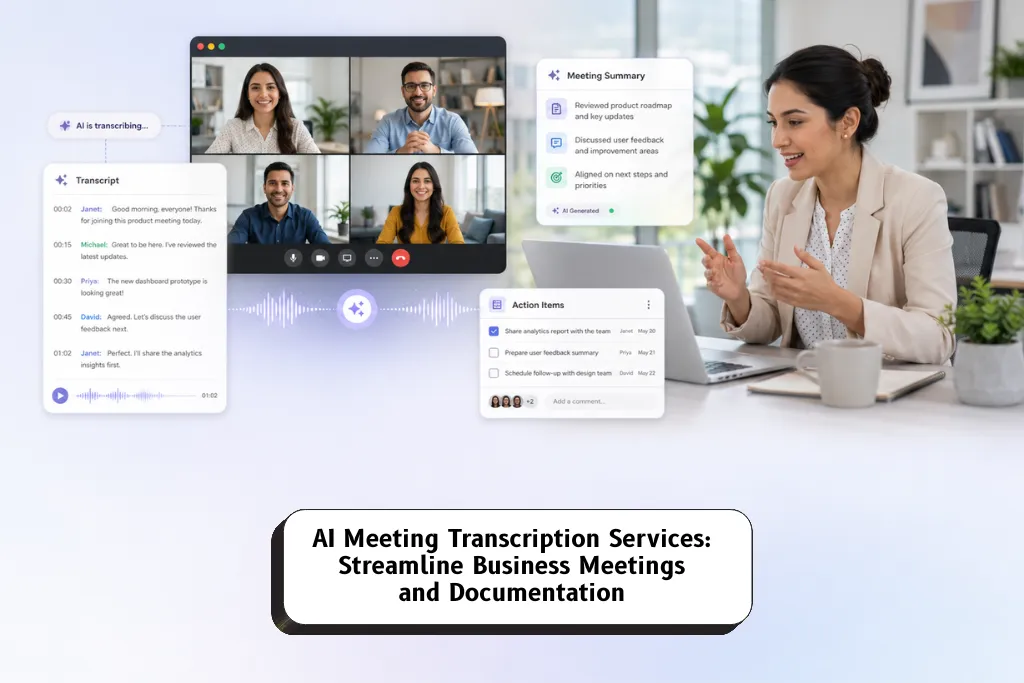
AI meeting transcription is a technology that uses artificial intelligence to convert spoken audio from online meetings, video calls, and in-person discussions into accurate, searchable text in real time. It works by joining or recording a meeting, transcribing the conversation as it happens, and then using AI to generate meeting notes, summaries, and action items automatically — removing the need for manual note-taking. For businesses running frequent sales calls, client meetings, and team check-ins across Zoom, Microsoft Teams, and Google Meet, this means every conversation becomes a searchable, shareable record that keeps distributed teams on the same page without anyone needing to type a single note.
Why AI Meeting Transcription Is Becoming a Business Essential
Meetings generate more information than anyone can retain by memory alone. Decisions and key points get lost between one call and the next, especially when teams juggle back-to-back online meetings across time zones. Manual note-taking is slow and inconsistent — one person’s meeting notes rarely capture what another would have written down.
AI meeting transcription handles this end-to-end. Meeting bots join scheduled video calls directly from a synced Google Calendar, record the conversation, and produce a full transcript along with a clear summary once the meeting ends. Teams that used to spend hours compiling meeting recaps report that transcription tools can save around five hours weekly by eliminating manual note-taking and follow-up chasing.
Accurate transcription also improves accessibility. Hearing-impaired team members gain equal access to conversations, and any meeting participant who was absent can catch up in minutes instead of asking colleagues to recap an hour-long call. New hires benefit the same way — onboarding becomes faster when they can review past meetings’ transcripts for context.
How AI Meeting Assistant Tools Actually Work
An AI meeting assistant typically operates through one of two paths: bots joining the call directly on supported meeting platforms, or manual upload of audio files and video files after the fact. Once captured, AI transcribes meetings using speech-recognition models trained to handle natural conversation, including interruptions and varying accents.
The output isn’t just raw text. A modern meeting transcription app adds structure on top of the transcript — speaker identification tags who said what, timestamps mark key points, and AI features automatically extract action items and key takeaways into a clear summary. This turns a wall of text into something a manager can scan in thirty seconds.
Many platforms also include an AI chat layer built directly into the transcript. Instead of scrolling through meeting transcriptions to find one detail, users can ask a question and get instant answers pulled straight from the conversation. This AI-powered search capability turns every past meeting into a queryable knowledge base rather than a static file sitting in a folder.
AI Meeting Transcription vs. Manual Note Taking
The gap between manual note-taking and AI-driven meeting notes is now significant enough that most growing teams treat transcription software as standard infrastructure.
Accurate transcription every time: AI doesn’t get tired, distracted, or selective about what it writes down. Every point raised in the discussion gets captured.
Searchable text instead of scattered notes: Transcripts are indexed and searchable, so finding what was said in a meeting from three weeks ago takes seconds.
Consistent meeting recaps: Everyone on the team works from the same clear summary, rather than five different interpretations of the same call.
Faster follow-ups: AI can draft follow-up emails and assign tasks straight from the discussion, so action items don’t sit forgotten in someone’s notebook.
Better focus during the call: When no one is heads-down typing, meeting participants stay more engaged and present in the actual conversation.
Where AI Meeting Agents Fit Into Everyday Business Use
Organizations across industries are finding practical, recurring uses for AI meeting agents beyond simple note-taking:
Sales teams use transcription to review sales calls for coaching, track objections, and pull direct quotes into CRM notes without re-listening to entire recordings.
Client-facing teams rely on meeting transcripts to keep records for compliance, training, and dispute resolution — where accurate documentation matters legally.
Cross-functional teams use transcripts and summaries to stay aligned across departments, so a meeting held by one group produces documentation the rest of the company can reference without attending.
Global teams benefit from multi-language support, which helps multilingual teams and native speakers of different languages collaborate without a language barrier slowing decisions down.
Training teams transcribe workshops and onboarding sessions so new employees can review past meetings for a refresher rather than depend on live attendance.
Choosing the Right AI Meeting Transcription App
Not all transcription tools are built the same, and the differences show up quickly once a team relies on them daily. When evaluating an AI tool for meeting transcription, a few factors matter most:
High accuracy across real conditions. Transcription quality depends heavily on how the tool handles background noise and overlapping speakers. Noise cancellation and speaker identification technology directly affect how usable the final transcript is.
Broad platform compatibility. A meeting assistant should work smoothly across Zoom meetings, Microsoft Teams calls, Google Meet, and other meeting platforms without requiring teams to change how they work, and should support uploading audio files and video files for meetings that weren’t captured live.
Collaboration features that go beyond the transcript. Easy sharing, searchable text, and the ability to assign tasks directly from a summary make the output usable by the whole team, not just the person who took the call.
Enterprise grade security. Meeting content often includes sensitive business information and client details. Any AI meeting transcription tool a business adopts should offer enterprise grade security, and teams should be transparent with meeting participants that AI transcription is active before the call begins.
Flexible plans. Many transcription tools offer a free plan for light use and paid plans, often billed annually, for teams that need unlimited transcription, advanced features, or a desktop app for offline work.
How AI and Human Oversight Work Together
AI handles the heavy lifting of transcription, summarization, and search — work that used to consume hours of manual effort. What AI captures accurately and at scale, people then use to make decisions, have follow-up conversations, and act on what was discussed. At Nambix Technologies, this is the model behind our AI meeting transcription services: AI-driven transcription and summarization at the core, with our team available to fine-tune outputs for specialized terminology, industry-specific formatting, or multilingual accuracy whenever a business wants that extra layer of polish.
Bringing AI Meeting Transcription Into Your Workflow
Adopting an AI meeting transcription workflow doesn’t require overhauling how a team already meets. Most tools integrate directly with existing meeting platforms and calendars, so the shift is largely invisible to meeting participants beyond a bot joining the call. What changes is what happens after: instead of someone drafting notes from memory, a full transcript, summary, and list of action items are ready within minutes.
For businesses handling frequent sales calls, client meetings, or cross-functional syncs, this shift compounds over time. Every future meeting builds on a searchable archive of past discussions, and every team member can trust that the record of what was said is accurate rather than paraphrased secondhand.
Nambix Technologies offers AI-powered meeting transcription services built for businesses that need accurate, secure, and scalable documentation across every call. Our solution supports multiple languages, integrates with major meeting platforms, and delivers accurate transcription with enterprise grade security — so your team can focus on the conversation, not the note-taking.
Frequently Asked Questions (FAQs)
1. What is AI meeting transcription and how does it work?
AI meeting transcription uses artificial intelligence to convert spoken audio from a meeting into written text, capturing everything said in real time or from an uploaded recording. It typically works through a bot joining the video call or through uploaded audio and video files, with speech-recognition models handling the conversion. Nambix Technologies applies this same AI-driven process to deliver accurate transcripts for business meetings, sales calls, and client discussions, with support for multiple languages and industry terminology.
2. How accurate is AI meeting transcription?
Accuracy depends on audio quality — background noise, overlapping speakers, and heavy accents can all affect transcription quality, though modern tools with noise cancellation and speaker identification handle most real-world conditions well. Nambix Technologies combines AI transcription with quality checks tailored to each client’s terminology, so businesses in specialized fields still get transcripts they can rely on for documentation and compliance.
3. Can AI meeting transcription tools work with Zoom, Google Meet, and Microsoft Teams?
Yes, most AI meeting assistants are built to join or integrate with major meeting platforms including Zoom meetings, Microsoft Teams calls, and Google Meet, often syncing with a Google Calendar to join scheduled calls automatically. Nambix Technologies’ transcription services are designed to work across these same platforms, so teams don’t need to change their existing meeting setup to start generating transcripts and summaries.
4. Does AI meeting transcription create action items and summaries automatically?
Yes — beyond producing a raw transcript, AI meeting transcription tools typically generate a clear summary, highlight key points, and identify action items so teams don’t have to sift through the full conversation to know what was decided. Nambix Technologies’ service includes automated summaries and task extraction as part of its meeting transcription offering, giving teams a ready-to-use recap after every call.
5. Is it necessary to inform meeting participants that AI transcription is being used?
Yes, businesses should let meeting participants know before enabling AI transcription, both as good practice and often as a legal requirement depending on the region. Nambix Technologies advises clients on transparent transcription practices as part of onboarding, ensuring meetings are documented responsibly alongside the technical setup.
6. Can AI meeting transcription handle meetings in multiple languages?
Many AI transcription tools now offer multi-language support, making them useful for multilingual teams and international client calls. Nambix Technologies specializes in multilingual transcription and can accurately transcribe meetings involving native speakers of different languages, which is especially valuable for global sales teams and cross-border collaboration.
7. Is meeting data secure when using AI transcription services?
Security depends on the provider — reputable transcription tools use enterprise grade security measures to protect sensitive meeting content, and businesses should review data-handling policies before adopting any AI tool for confidential discussions. Nambix Technologies prioritizes secure handling of all transcribed content, giving businesses a dependable option for transcribing sales calls, client meetings, and internal discussions without compromising data privacy.
