
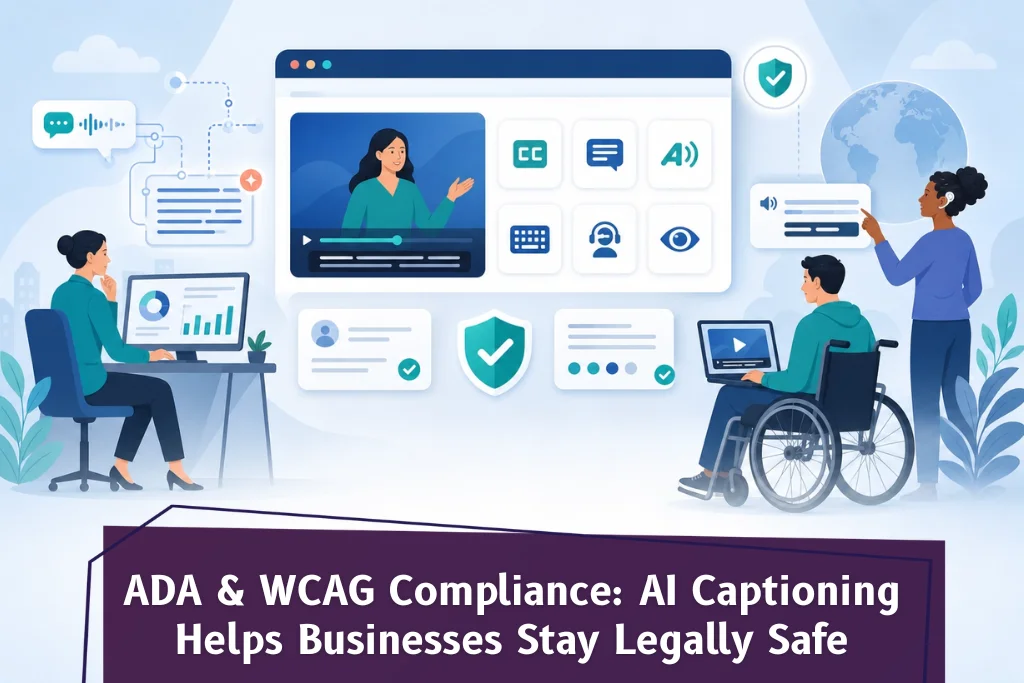
In 2026, ADA WCAG compliance is no longer optional — it is a binding legal requirement for businesses operating websites, apps, and digital platforms. This blog explains what the Web Content Accessibility Guidelines (WCAG) demand from website owners today, how the European Accessibility Act has expanded these obligations globally, what success criteria your digital content must meet to avoid lawsuits, and how AI-powered captioning helps your business achieve Level AA conformance quickly and cost-effectively — while providing equal access to people with disabilities across every web page you publish.
Understanding ADA WCAG Compliance and Digital Accessibility in 2026
The Americans with Disabilities Act has long required businesses to provide equal access to their goods and services — and courts have consistently extended this to digital channels under Title III. In parallel, the World Wide Web Consortium, through its Web Accessibility Initiative, developed the Content Accessibility Guidelines WCAG as the accepted technical standard for making websites accessible to people with different disabilities, including those with hearing loss, visual impairments, motor difficulties, and learning disabilities.
The most current version, WCAG 2.2, builds on WCAG 2.1 and WCAG 2.0 with new success criteria focused on user interface components, input purpose, and mobile devices. Level AA remains the widely accepted benchmark for legal compliance, while Level AAA conformance represents the highest tier of accessibility — aspirational for most organisations but required in some regulatory contexts. The European Accessibility Act, which came into full enforcement in June 2025, further raised global stakes by requiring products and services in information and communication technology — including websites and digital media — to meet accessibility standards across EU member states. For businesses operating internationally, digital accessibility is no longer a domestic compliance issue. The rules apply across borders, and businesses that ignore them risk simultaneous exposure in multiple jurisdictions.
Why Captions Are Central to WCAG Compliance and Specific Requirements
Among the specific requirements in WCAG, captioning is one of the most explicitly mandated. Success Criterion 1.2.2 at Level AA requires that all prerecorded audio in synchronized media must provide captions. Success Criterion 1.2.4 extends this to live broadcasts. These are hard conformance requirements, not soft recommendations.
Text alternatives and captions allow information presented through audio-visual formats to reach users with hearing loss, people in sound-restricted environments, and those using assistive technologies like screen readers. Without captions, a web page containing video content automatically fails Level AA conformance — exposing businesses to legal risk under both the disabilities act and international frameworks like the European Accessibility Act. WCAG guidelines further require that captions accurately reflect spoken dialogue, identify speakers, and capture non-speech sounds that are meaningful to understanding the content. This raises the quality bar beyond basic auto-generated text, making AI captioning with high accuracy the only practical and scalable solution for most organisations.
New Success Criteria, User Interface Components, and the European Accessibility Act
WCAG 2.2 introduced several new success criteria that website owners must now address. Focus Appearance at Level AA ensures that user interface components like buttons and form fields have a visible keyboard focus indicator. Accessible Authentication reduces cognitive barriers from login flows, benefiting users with learning disabilities. Color contrast requirements remain essential, and a website’s layout must be navigable without reliance on visual elements alone.
The European Accessibility Act aligns closely with WCAG Level AA, meaning WCAG conformance is the practical path to compliance for most digital businesses in EU markets. For government websites and federally funded entities in the US, the Rehabilitation Act similarly mandates conformance with the current version of the web content accessibility guidelines. Taken together, these frameworks mean that a web accessibility policy is now a business necessity, not a best-practice recommendation.
How AI Captioning Helps Businesses Fix Accessibility Issues at Scale
Large organisations publish hundreds of hours of video content yearly across training, marketing, and customer service channels. Manually captioning this volume is cost-prohibitive. AI captioning resolves this bottleneck — processing video in real time, generating accurate captions across multiple languages, and producing output formatted to meet WCAG requirements, including proper punctuation, speaker identification, and synchronized text alternatives.
AI captioning can also be integrated into live broadcast environments, satisfying the Level AA requirement for live captions. This makes it relevant not just for prerecorded content but for webinars, live events, and real-time communication technology platforms — all of which fall within scope of the European Accessibility Act and the Rehabilitation Act. For website owners who have been avoiding compliance due to cost, AI captioning removes the primary financial barrier. Improving accessibility across an entire website’s video content is no longer a multi-year manual project — it is an automated workflow that scales with your content output.
Nambix Technologies offers AI Captioning services purpose-built for businesses that need to meet WCAG requirements at scale. With accuracy up to 99.8% and real-time processing, Nambix delivers captions that satisfy the technical standard for Level AA conformance — covering both prerecorded and live content across web pages, mobile devices, and digital platforms. Beyond captioning, Nambix provides AI Transcription, AI Subtitling, and AI Translation, enabling businesses to achieve digital accessibility and WCAG compliance at scale. To learn more or request a demo, visit https://nambix.com/
Frequently Asked Questions (FAQs)
1. What is the difference between ADA compliance and WCAG conformance?
ADA compliance is the legal obligation to provide equal access to people with disabilities, including through digital channels under Title III. WCAG conformance means meeting the specific success criteria in the web content accessibility guidelines. Courts treat WCAG Level AA as the practical benchmark for ADA compliance — meaning failing to provide captions for video is both a WCAG failure and potential legal exposure.
Nambix’s AI Captioning delivers accurate, properly timed captions formatted to the technical standard WCAG requires, helping businesses satisfy both the legal requirement and the conformance criteria on the same page.
2. Does WCAG 2.2 replace WCAG 2.1, and do I need to update my website?
WCAG 2.2 is the most current version and is backward compatible with WCAG 2.1 and WCAG 2.0. It adds new success criteria around user interface components and accessible authentication. Businesses that achieved WCAG 2.1 Level AA conformance still need to review these additions to remain current.
Nambix helps ensure your video and audio content — one of the most commonly non-compliant areas — is fully captioned and meets updated requirements without adding complexity to your remediation workflow.
3. Does the European Accessibility Act apply to my business?
The European Accessibility Act applies to businesses offering products and services in the EU, including websites, apps, and information and communication technology services. It came into full enforcement in June 2025. Non-EU companies operating in European markets are also in scope, and the technical standard referenced by the EAA aligns closely with WCAG Level AA.
Nambix supports multilingual AI captioning across dozens of languages, helping businesses meet both content accessibility and language accessibility requirements under the European Accessibility Act through a single scalable service.
4. Are captions only required for people with hearing loss?
WCAG guidelines recognise that captions benefit a wider range of users — people in noisy environments, non-native speakers, users with learning disabilities, and anyone accessing content on mobile devices without sound. This is why captions are a Level AA requirement rather than a Level AAA option reserved for niche use cases.
Nambix’s AI Captioning delivers accurate, readable captions available across languages, ensuring your content reaches every user effectively — not just those with hearing loss.
5. What happens if my website fails a WCAG accessibility audit?
Businesses can face legal action under ADA Title III, the Rehabilitation Act, and the European Accessibility Act. Courts can award damages and require full remediation of an entire website within set timeframes. Inaccessible websites also exclude a significant customer segment — over one billion people globally live with some form of disability.
The fastest path to fixing accessibility issues in audio-visual content is AI captioning at scale. Nambix Technologies makes this possible quickly, with captions that meet the quality threshold WCAG conformance requires.
6. What is Level AA conformance, and is Level AAA required?
Level AA is the mid-tier of WCAG conformance and the standard most legal frameworks treat as the required benchmark. Level AAA includes additional requirements — such as sign language interpretation — that are recommended as best practice but not legally mandated for most websites.
Nambix’s captioning service is calibrated to Level AA requirements, giving businesses a clear, auditable compliance baseline without over-engineering their accessibility programme.
7. How quickly can AI captioning be deployed across an existing video library?
AI captioning can be deployed far faster than manual workflows. With Nambix Technologies’ platform, businesses can caption large volumes of existing video content in a fraction of the time required by human-only processes — making it practical to bring legacy content libraries into WCAG conformance ahead of audit or litigation deadlines.
For businesses with multilingual content, Nambix’s AI Captioning, AI Transcription, and AI Translation services address digital accessibility across your entire global content library from a single integrated platform.
