
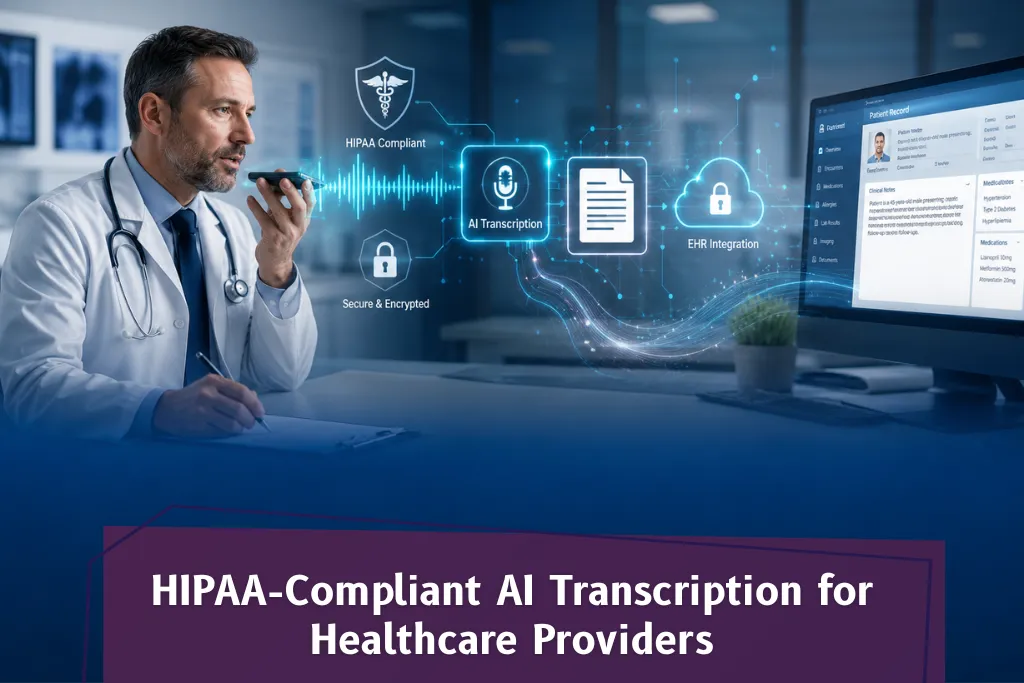
Healthcare providers who record patient consultations, therapy sessions, or clinical dictations need more than fast turnaround — they need a transcription solution that is fully HIPAA compliant. HIPAA-compliant AI transcription converts audio recordings of patient encounters into accurate, structured text while protecting protected health information (PHI) through encryption, access controls, and audit trails, so healthcare organizations can meet the security requirements of the Health Insurance Portability and Accountability Act at every stage of the transcription process. This blog explains what HIPAA compliance actually requires, how AI-powered transcription tools meet those requirements, and what to look for in a compliant transcription software before you upload a single audio file.
Why HIPAA Compliance Matters for Medical Transcription
Every clinical note, therapy note, and set of patient records contains deeply personal information — diagnoses, medication history, mental health disclosures, and financial details. When that information moves through a transcription request, it doesn’t stop being protected. HIPAA compliance matters because it defines the legal and technical boundary between routine documentation and a reportable data breach.
Under HIPAA, healthcare providers are responsible for the compliance of any third-party vendor that touches patient data, including transcription services. That means choosing a transcription tool isn’t just an operational decision; it’s a compliance decision. HIPAA rules require administrative, physical, and technical safeguards for any system that stores or transmits PHI, and those obligations apply whether the notes are typed by a person or generated by AI transcription software. Healthcare organizations that skip this step aren’t just risking inaccurate transcripts — they’re risking fines, breach notifications, and loss of patient trust.
What Makes Transcription Software HIPAA Compliant
There’s no government-issued “HIPAA certified” badge — no vendor can legitimately claim official certification, because HIPAA compliance is a set of safeguards and obligations, not a stamp. What matters is whether the software actually implements the required protections. A hipaa compliant transcription software should include:
End-to-end encryption for audio files and text during transmission and while stored, so patient data is unreadable to anyone without authorized access.
A signed Business Associate Agreement (BAA), which legally binds the transcription vendor to the same privacy obligations as the healthcare provider.
Role-based access controls, limiting who inside and outside the organization can view transcribed notes.
Audit trails that log every access point and modification to PHI, so healthcare providers can show exactly who viewed or edited a file and when.
Regular staff training on privacy standards for anyone who handles PHI as part of the transcription workflow.
Without these elements, even a fast, accurate transcription tool isn’t fully HIPAA compliant — it’s simply a productivity tool operating outside the compliance boundary healthcare organizations are required to maintain.
How AI Transcription Delivers Accuracy in Clinical Settings
Modern medical transcription software has come a long way from generic speech-to-text. Purpose-built AI transcription models are trained on clinical language, medical terminology, and the phrasing patterns common in exam rooms, patient consultations, and behavioral health sessions. This training is what separates accurate transcription from a rough draft.
Key capabilities that improve accuracy in clinical settings include:
Multi-speaker recognition for patient encounters involving multiple speakers — a physician, a patient, and sometimes a caregiver or interpreter.
Noise handling, since exam rooms and virtual visits often carry background noise that can distort audio quality.
Support for multiple languages, helping healthcare providers serve diverse patient populations without switching tools.
Structured output formats, including SOAP-style notes, so clinical notes and progress notes are ready to drop into a patient’s chart rather than needing to be reformatted.
Broad supported audio formats, so recordings from scheduled calls, in-office visits, or research interviews can all be processed without conversion headaches.
AI transcription accuracy also compounds over time. As transcription tools process more medical reports, therapy notes, and progress notes, they get better at recognizing specialty-specific clinical language — meaning a psychiatrist’s progress notes and a cardiologist’s exam summary are both handled with the nuance their specialty demands.
Behavioral Health and Mental Health Professionals: A Closer Look
Behavioral health has some of the highest stakes when it comes to transcription accuracy and confidentiality. Therapy sessions often include disclosures that are more sensitive than a typical physical exam — trauma history, substance use, family conflict — and mental health professionals need transcription tools that treat that information with the same rigor a paper chart locked in a filing cabinet would.
For mental health professionals, HIPAA-compliant transcription supports:
Turning therapy sessions into clean, searchable therapy notes without manual note-taking during the session, so clinicians can stay present with patients.
Maintaining consistent documentation across private practices, where a single missed detail in a progress note can affect care continuity.
Producing transcribed notes that hold up if requested for insurance review, audits, or continuity-of-care referrals.
Keeping patient information secure through the same encryption and access controls used across all clinical settings, not a lighter version because the setting is outpatient.
Given how much of behavioral health documentation depends on nuance and tone, accurate transcription isn’t a convenience — it directly supports patient outcomes by giving mental health professionals a reliable, timestamped record of what was actually said in the room.
What Happens When Transcription Tools Aren’t Compliant
Non-compliant tools might look identical to compliant transcription software on the surface — same interface, same free plan, same promise of fast turnaround. The difference shows up in what’s happening underneath. Non-compliant transcription services often:
Skip the Business Associate Agreement entirely, leaving healthcare organizations without a legal safeguard if something goes wrong.
Store audio files and transcripts on unsecured servers, increasing the risk of a data breach.
Rely on weak or absent access controls, meaning PHI could be viewed by more people, internally or externally, than necessary.
Offer no audit trail, so there’s no way to prove who accessed a patient’s records or when.
The result of using non-compliant transcription services isn’t just a compliance gap on paper — it’s a real risk of HIPAA violations, financial penalties, and, most importantly, exposure of deeply personal patient information that was never meant to leave the exam room.
How Nambix Technologies Supports HIPAA-Compliant Transcription
Nambix Technologies is built for healthcare organizations that need transcription accuracy and compliance in the same workflow. Nambix’s AI transcription services are engineered around secure processing, encrypted audio and text handling, and structured output designed for clinical use — so patient consultations, therapy sessions, and medical dictation move from audio recordings to hipaa compliant notes without adding extra steps to an already busy day.
Because Nambix’s transcription engine is trained on clinical and behavioral health language, it recognizes medical terminology, multiple speakers, and specialty-specific phrasing across multiple languages — helping healthcare providers, private practices, and mental health professionals get clinical notes, progress notes, and medical reports that reflect what was actually said, formatted for the way healthcare teams actually work. With scalable processing built for high-volume patient encounters and a workflow designed to fit into existing systems, Nambix helps healthcare organizations turn audio transcription into reliable, secure documentation — quickly, and without compromising on compliance standards.
Frequently Asked Questions (FAQs)
1. What does it mean for transcription software to be HIPAA compliant?
It means the tool meets HIPAA’s requirements for protecting PHI — encryption of data in transit and at rest, access controls, audit trails, and a signed Business Associate Agreement with the vendor. Nambix Technologies builds these safeguards directly into its AI transcription workflow, so healthcare providers don’t have to bolt on compliance separately.
2. Is a Business Associate Agreement always required for transcription services?
Yes — if a vendor handles PHI on behalf of a healthcare provider, HIPAA requires a signed BAA outlining each party’s responsibilities for protecting that data. Nambix Technologies provides this agreement as part of onboarding for healthcare clients, so the compliance relationship is clear from day one.
3. Can AI transcription handle medical terminology accurately?
Yes, when the underlying model is trained specifically on clinical and behavioral health language rather than general speech. This is what allows transcripts to correctly capture medication names, diagnoses, and specialty-specific phrasing. Nambix Technologies’ AI transcription is tuned for exactly this kind of clinical accuracy, across patient encounters and multiple speakers.
4. How is patient data protected during the transcription process?
Audio files and resulting text should be encrypted both while being transmitted and while stored, with role-based access limiting who can view them, plus an audit trail logging every access point. Nambix Technologies applies these protections across every transcription request, so patient records stay secure from upload to delivery.
5. Is HIPAA-compliant transcription suitable for behavioral health and therapy notes?
Yes — behavioral health documentation often involves especially sensitive disclosures, so compliant transcription tools apply the same encryption and access standards to therapy notes as they do to any other clinical record. Nambix Technologies supports mental health professionals with accurate, secure transcription built for the confidentiality therapy sessions require.
6. What audio formats do HIPAA-compliant transcription tools typically support?
Most support common audio and video formats used in clinical settings, including recordings from scheduled calls, in-person visits, and research interviews, so healthcare teams don’t need to convert files before submitting them. Nambix Technologies accepts a wide range of supported audio formats, making it easy to fit into an existing clinical workflow.
7. What’s the risk of using a transcription tool that isn’t HIPAA compliant?
Non-compliant tools can expose PHI through weak security, missing audit trails, or the absence of a BAA — putting healthcare organizations at risk of HIPAA violations and financial penalties. Nambix Technologies is built around the safeguards HIPAA requires, so healthcare providers can adopt AI transcription without taking on that risk.
