
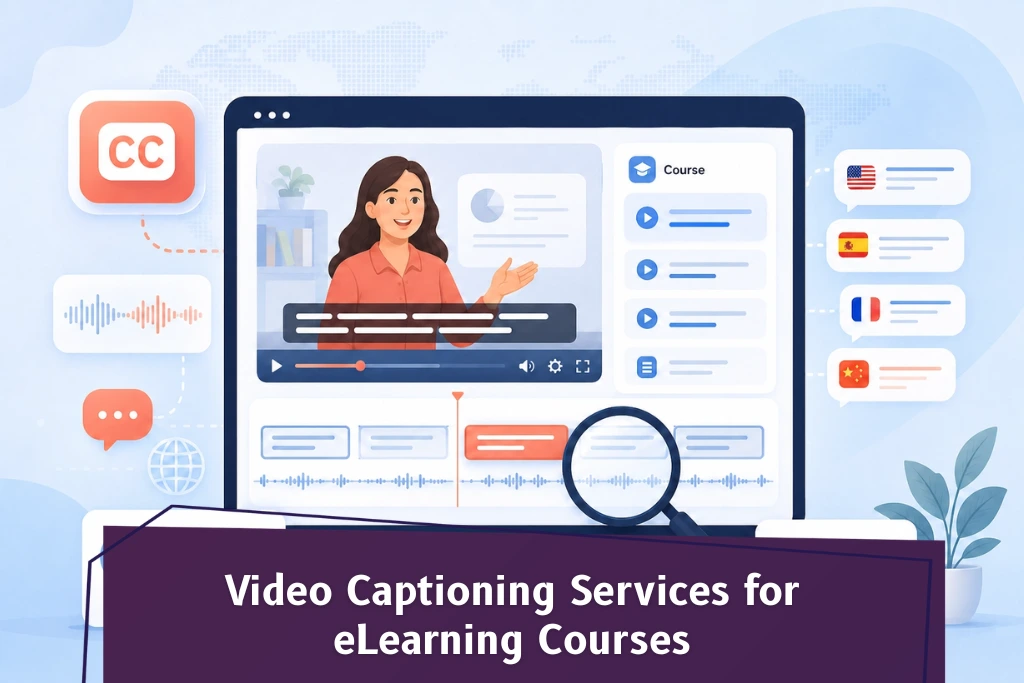
This blog explains how video captioning services help eLearning creators and online course platforms deliver accurate transcription, multilingual subtitles, and closed captions that make educational video content fully accessible to a global audience. From leveraging AI-powered captioning tools to combining automated and human transcription workflows, this guide covers everything educators, instructional designers, and eLearning platform operators need to know about adding accurate subtitles to course videos — and how doing so boosts learner engagement, drives accessibility compliance, and expands reach across multiple languages worldwide.
Why eLearning Cannot Afford to Skip Video Captioning Services
The global eLearning market is on an unstoppable growth trajectory, with learners tuning in from every corner of the world. Yet a significant portion of video content is still published without captions — silently locking out non-native speakers, learners with hearing impairments, and students watching in noisy environments where audio is not practical.
Video captioning services solve this by converting the spoken content in course videos into perfectly synced on-screen text. This isn’t simply an accessibility checkbox — it’s a measurable business advantage. Research consistently shows that courses with accurate captions enjoy higher watch time, stronger completion rates, and better knowledge retention. Closed captions also make every word of your video content crawlable by search engines, helping your course catalog rank higher and reach a wider audience organically.
For eLearning platforms serving global learners across time zones, languages, and learning conditions, the presence or absence of captions often defines whether a course succeeds in new markets.
How AI-Powered Transcription Is Transforming eLearning Content
Traditional manual transcription was slow, expensive, and difficult to scale for large course libraries. Today, ai powered transcription has fundamentally changed how eLearning teams produce and publish content. Driven by automatic speech recognition and natural language processing, modern ai transcription platforms can process audio files and video files with remarkable speed — turning hours of recorded lectures into accurate transcripts in minutes.
The best transcription services now combine the efficiency of machine learning with the refinement of human transcription. This hybrid approach ensures that the final output meets the high quality that eLearning demands — especially when dealing with multiple speakers, technical vocabulary, background noise, or content recorded in noisy environments.
For eLearning teams managing longer videos or entire content libraries, the ability to auto generate subtitles through ai tools isn’t just a convenience — it’s a competitive necessity. Automated transcription services dramatically cut production timelines while maintaining transcription accuracy across multiple languages, enabling faster go-to-market across global regions.
The Power of Accurate Subtitles for Global Learners
When course creators add subtitles to their video content, they are doing far more than meeting compliance requirements. Accurate subtitles make your spoken content legible and comprehensible for global learners — whether they are watching via mobile apps on a commute, studying in a second language, or accessing courses in regions with unreliable internet audio.
Closed captions serve a dual purpose: they support learners with hearing difficulties (a legal requirement in many countries) and enhance comprehension for all learners processing complex, fast-paced, or technical audio content. Standard caption formats like SRT and VTT integrate smoothly with most LMS platforms, while speaker identification and speaker labels help learners follow multi-participant discussions such as panel lectures or group tutorials.
Adding captions through professional video captioning services also delivers significant SEO value. Search engines read caption files and automated transcripts, effectively turning every spoken word in your course into indexed, searchable text — boosting discoverability and driving more organic traffic to your eLearning platform.
Choosing the Best Transcription Services for eLearning
Not all transcription tools are built equally. When evaluating the best transcription apps and platforms for eLearning, course creators should look beyond pricing and consider:
Transcription accuracy across accents, technical terms, and speaker names
Support for multiple languages to serve international learners
Speaker identification for recordings that involve multiple speakers
Flexible export options for subtitle files in SRT, VTT, and TXT formats
Collaboration features for team review, the ability to edit subtitles, and quality control workflows
Integration with tools like Google Drive, your LMS, or media platforms for smooth video upload and the ability to export transcripts quickly
The best transcription apps today deliver ai powered transcription as a baseline, then layer in human-powered transcription review for high-stakes or domain-specific audio recordings — exactly the combination eLearning producers working with technical, medical, or legal content need most. Look for platforms that support data annotation pipelines for specialized vocabulary and offer team collaboration capabilities when multiple reviewers are involved.
Nambix Technologies: AI-Powered Video Captioning Built for eLearning Scale
Nambix Technologies offers enterprise-grade video captioning services and AI transcription solutions built for teams that need speed, high accuracy, and global scale. eLearning providers can upload audio files and video files — from short micro-lessons to longer videos spanning several hours — and receive perfectly synced, highly accurate captions delivered rapidly.
Nambix’s AI captioning and ai powered transcription services leverage advanced automatic speech recognition, natural language processing, and data annotation workflows to produce accurate captions even in challenging conditions — background noise, multiple speakers, or content recorded across multiple languages. Their platform supports speaker identification, speaker labels, and multiple caption formats to match your LMS requirements precisely.
For teams requiring the most accurate transcription, Nambix blends automated transcription services with professional human transcription review — ensuring that completed transcripts and auto captions meet the quality bar that eLearning content demands before reaching global learners. Whether your goal is to add subtitles to a single course or run automated transcriptions across a full content library, Nambix provides the technology and expertise to make it scalable.
Their AI captioning services also help highlight key points within transcripts through ai summary features, making content easier for learners to navigate — while their multilingual captioning capabilities help eLearning platforms expand to a global audience with accurate subtitles in dozens of languages.
Frequently Asked Questions (FAQs)
1. What are video captioning services, and why does eLearning need them?
Video captioning services convert the spoken content in a video into on-screen text that is perfectly synced with the audio. For eLearning, captions ensure that global learners — regardless of language, hearing ability, or listening environment — can fully access course content. They also support compliance with accessibility standards like ADA and WCAG 2.1.
Nambix Technologies provides AI-powered video captioning services designed for eLearning teams, delivering accurate captions quickly across multiple languages so online courses can reach and serve learners worldwide without barriers.
2. How accurate is AI transcription for educational video content?
AI transcription accuracy has improved dramatically with advances in automatic speech recognition and natural language processing. Most modern platforms achieve high accuracy on clear audio. However, accuracy can dip with heavy accents, background noise, or domain-specific vocabulary — which is why a hybrid of ai powered transcription and human review is the recommended approach for eLearning audio and video content.
Nambix Technologies combines AI transcription with human-powered transcription review to deliver the most accurate transcription possible — including lectures with multiple speakers, technical vocabulary, and audio recordings captured in varied conditions.
3. Can I auto generate subtitles for an entire eLearning course library?
Yes. Modern automated transcription services let you upload audio and video files in bulk and auto generate subtitles at scale, which is ideal for eLearning platforms with large libraries of recorded lectures, training modules, or webinars. Automated transcripts generated this way can be reviewed, refined, and published quickly even under tight production schedules.
Nambix Technologies supports batch video uploads through its AI captioning platform, enabling teams to generate subtitles for entire course libraries efficiently. Each set of automated transcriptions goes through accuracy review before delivery, ensuring consistent, publish-ready accurate subtitles.
4. What caption formats are supported for LMS integration?
The most widely used caption files for LMS platforms are SRT (SubRip), VTT (WebVTT), and SCC. These formats carry the subtitle text together with timestamps that keep accurate subtitles perfectly synced with your audio and video. Most LMS platforms — including Moodle, Blackboard, Canvas, and TalentLMS — accept at least one of these formats, and many support direct subtitle files upload.
Nambix Technologies exports caption files in multiple formats for smooth LMS integration. Their team can also help you edit subtitles or reformat files to meet the specific requirements of your hosting platform or paid plans workflow.
5. How do closed captions help eLearning content rank on search engines?
Search engines cannot watch video content but they can read text. When you add subtitles and closed captions — or publish automated transcripts alongside your course videos — all of the spoken content becomes indexed, crawlable text. This significantly improves your video content’s ranking in search results, drives more organic traffic, and helps you highlight key points that match learner search queries.
Nambix Technologies’ video captioning services produce accurate transcripts and caption files that are fully readable by search engines — helping eLearning platforms increase course discoverability and grow their global audience organically over time.
6. Is human transcription still necessary when AI tools are so advanced?
AI tools have made audio transcription remarkably fast and cost-effective, but human review still adds critical value for content featuring noisy environments, varied accents, multiple speakers, or highly specialized vocabulary. Human-powered transcription review catches nuances — such as filler words, correct speaker names, and ambiguous phrasing — that automated transcriptions occasionally miss.
Nambix Technologies offers a best-of-both approach: ai powered transcription for speed and scale, with expert human review for transcription accuracy. This means even the most complex eLearning audio content is refined to the highest standard before it reaches global learners.
7. How do video captioning services help eLearning platforms reach a global audience?
Video captioning services remove language, hearing, and environmental barriers from online learning. Accurate subtitles in multiple languages allow a single course to be localized for dozens of markets, while closed captions ensure learners with hearing impairments are never excluded. Captions also extend watch time among learners who prefer reading along with the audio and video simultaneously.
Nambix Technologies specializes in multilingual video captioning and AI transcription for global eLearning deployments. With support for multiple languages, data annotation for specialized terms, and machine learning workflows tuned for transcription accuracy, Nambix helps eLearning providers scale their content to a truly global audience — effectively and affordably.
